
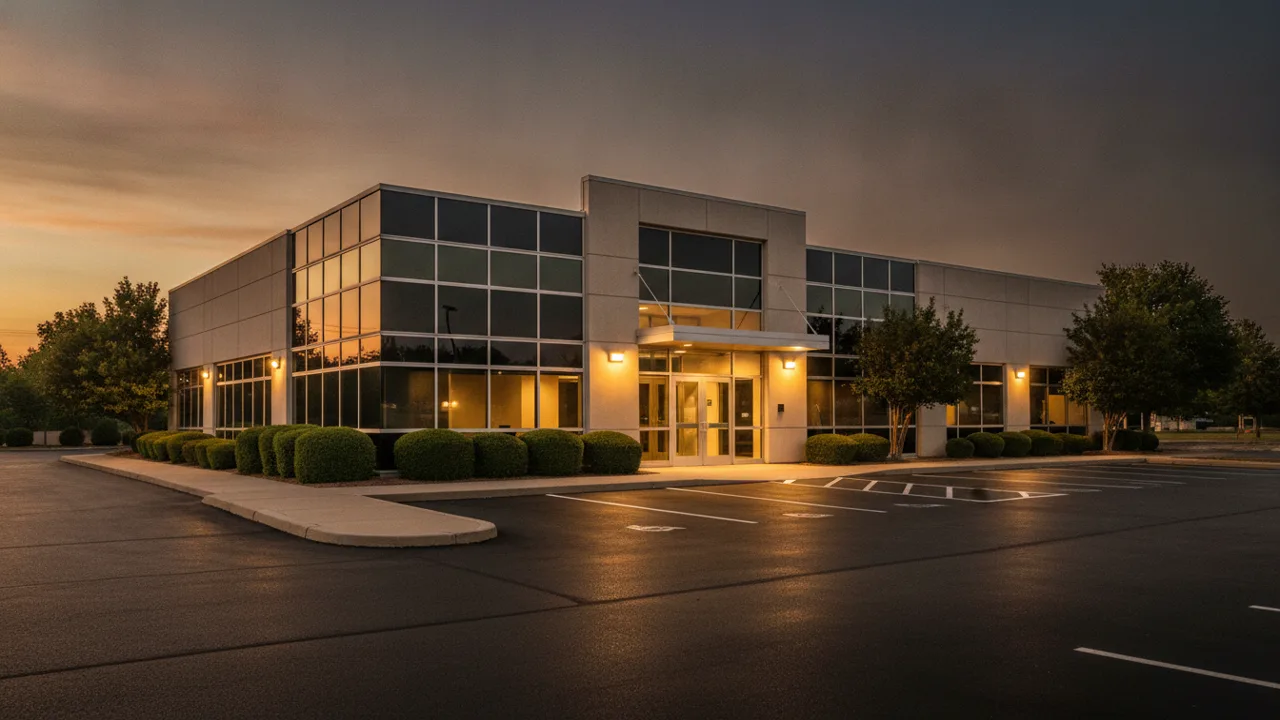
Commercial Office Loans
Office financing spans two distinct lending paths: investment office (you buy and lease to others) and owner-user office (your business owns and occupies the space). We originate both, across traditional office, medical office, and flex/office-warehouse buildings nationwide.
Office is a specialized asset class post-2020. Lenders look closely at tenant quality, lease terms, remote-work exposure, and submarket vacancy. Medical office in particular has become one of the strongest-performing commercial asset classes.
Check Office Loan Eligibility Talk to an Office Specialist — (833) 350-9185Quick answer: Office loans cover both investment office (buy and lease to others) and owner-user office (your business owns and occupies the space), across traditional, medical, and flex/office-warehouse buildings. Qualified on the property’s cash flow. Available nationwide.
Two Paths: Investment vs Owner-User
Investment Office (Landlord)
You own the building and lease to tenants. Classic commercial underwriting based on NOI.
| Feature | Typical Range |
|---|---|
| Loan amounts | $500K – $7.5M+ |
| LTV | 60–70% |
| DSCR minimum | 1.25–1.35 |
| Amortization | 25 years |
| Term | 5, 7, 10-year balloon |
| Min occupancy | 85% with weighted average lease term 3+ years |
Owner-User Office (SBA or Conventional)
Your business owns the building and operates from it. Very different program — often SBA 504 or SBA 7(a) with 85–90% LTV.
| Feature | Typical Range |
|---|---|
| Loan amounts | Up to $5M (SBA 504) |
| LTV | Up to 90% (SBA 504 structure) |
| Amortization | 20–25 years |
| Term | Up to 25 years fixed |
| Occupancy rule | Must occupy 51%+ within 12 months |
Owner-user is often the better path for medical practices, law firms, CPAs, and professional services that otherwise lease. The math frequently favors owning over leasing once the business has 3+ years of stable revenue.
Medical Office Is a Separate Game
Medical office buildings (MOBs) trade at tighter cap rates than general office — sometimes 75–100 basis points tighter — because of:
- Sticky tenants (medical practices don’t easily relocate due to equipment, patient relationships, permits)
- Non-discretionary demand (patients come regardless of economic conditions)
- Recession resilience proven across multiple cycles
- Growing demographic tailwinds (aging population)
Lenders price MOB financing more aggressively than general office. If your deal is medical office with long-lease credit tenants, flag it early — the pricing sheet is different.
Who Buys Office
- Investors acquiring multi-tenant office in stabilized markets
- Medical practices buying their own office building (owner-user)
- Professional service firms moving from leasing to owning
- 1031 exchange buyers diversifying out of multi-family
- Institutional buyers acquiring medical office portfolios
- Opportunistic investors buying distressed office at reset basis
Sample Scenario: Medical Office Investment
3-Tenant Medical Office, Charlotte NC
- Property: 12,500 SF single-story medical office, built 2005, 95% occupied
- Purchase price: $4,200,000
- Down payment: $1,260,000 (30%)
- Loan amount: $2,940,000
- Tenants: Primary care (5,000 SF, 8-year lease), imaging (4,500 SF, 10-year lease), physical therapy (2,500 SF, 5-year lease)
- Gross rents: $31,250/month NNN
- Operating expenses: landlord pass-through minimal on NNN; budget $2,500/mo landlord reserves
- NOI: approximately $345,000/yr
- Debt service (25-yr): $232,000/yr
- DSCR: $345,000 ÷ $232,000 = 1.49
- Result: Approved. Strong medical tenancy, long lease terms, credit-stable cash flow.
Current Office Underwriting Climate
Lenders are cautious on general office post-2020. Expect:
- Lower LTV than multi-family or industrial (typically 60–65% vs 70–75%)
- Higher DSCR requirement (1.30–1.40 vs 1.20–1.25 elsewhere)
- Stricter tenant quality review — national credit tenants and long WALT (weighted average lease term) help; month-to-month hurts
- Submarket vacancy scrutiny — CBDs with 20%+ vacancy may get declined even with stabilized property
- Tenant improvement (TI) reserves often required at closing
Medical office gets significantly better treatment than general office. Suburban office outperforms CBD office in most markets.
Frequently Asked Questions
Related Commercial Products
- Commercial Loans Hub — Full overview
- Multi-Family Loans — 5+ unit apartment buildings
- Mixed-Use Loans — Office combined with residential
- Retail Loans — Pure retail properties
- Industrial Loans — Warehouse and flex
- Self-Storage Loans — Industrial-adjacent passive cash flow
1st Nationwide Mortgage, NMLS 1281. Commercial office loans subject to property, tenant, and sponsor underwriting. Medical office, general office, and owner-user programs have different requirements. Not all applicants or properties will qualify.
Ready to Get Started?
Talk to a licensed loan officer about your options — no obligation.