
Mixed-Use Commercial Loans
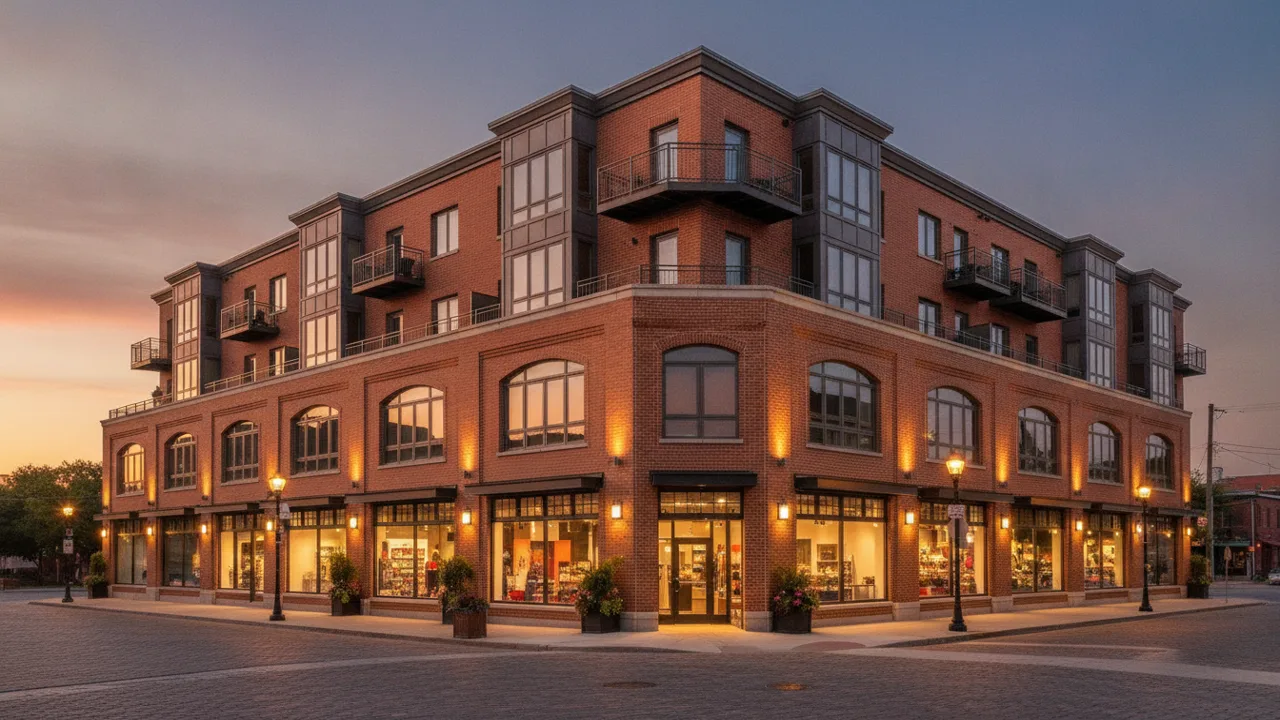
Mixed-use properties — retail or office on the ground floor, apartments above — sit in an underwriting gray zone. Residential DSCR won’t touch them. Pure commercial lenders treat them as commercial. Mixed-use financing is the specialized program that handles the combo.
Common in walkable urban corridors, traditional main streets, and converted historic buildings, mixed-use is often the best value-per-square-foot investment in a market.
Check Mixed-Use Loan Eligibility Talk to a Mixed-Use Specialist — (833) 350-9185Quick answer: Mixed-use loans finance properties that combine commercial and residential space — typically retail or office on the ground floor with apartments above. Residential DSCR won’t cover them and pure commercial lenders treat them as commercial; mixed-use financing is the program built for the combination. Available nationwide.
Program Highlights
| Feature | Typical Range |
|---|---|
| Loan amounts | $500,000 – $7,500,000 |
| LTV | Up to 70% |
| DSCR minimum | 1.20–1.30 |
| Residential mix requirement | 25–75% of NRA typically residential for best pricing |
| Amortization | 25 or 30 years |
| Term | 5, 7, or 10-year fixed with balloon |
| Commercial tenants | Stable, non-special-purpose (see exclusions below) |
| Recourse | Typically recourse under $2M; non-recourse available above |
| Vesting | LLC preferred |
Better pricing when residential share is higher. A property that’s 60% apartments + 40% retail generally gets better terms than 40% apartments + 60% retail, because residential income is viewed as more stable.
Commercial tenant types that complicate underwriting: restaurants with grease exposure, auto repair / dry cleaners (environmental), bars, adult use, cannabis. Not deal-breakers, but pricing and LTV may be impacted.
Who Buys Mixed-Use
- Urban investors buying traditional main-street buildings
- Live-above-the-shop buyers (owner-occupied retail with residential above; different program structure)
- Conversion buyers turning historic commercial into mixed-use
- Scaling multi-family owners diversifying into mixed-use for yield
- 1031 exchange buyers moving equity into a single higher-value mixed-use property
Sample Scenario
Main-Street Mixed-Use in Asheville, NC
- Property: 2-story building, ground floor retail (coffee shop, 1,800 SF), 4 apartments above (2BR each)
- Purchase price: $1,450,000
- Down payment: $435,000 (30%)
- Loan amount: $1,015,000
- Monthly rents: $4,200 retail + $6,000 (4 × $1,500) residential = $10,200
- Gross annual income: $122,400
- Operating expenses: $34,200/yr (28% OER — typical for small mixed-use)
- NOI: $88,200
- Debt service (30-yr): $76,800/yr
- DSCR: $88,200 ÷ $76,800 = 1.15 (below program min — sponsor adds $50K reserves)
- Result: Approved with compensating reserves. Bridge-to-perm if tenant needs to be replaced.
Mixed-Use Underwriting Differences
Commercial appraisers value mixed-use on blended income — residential portion valued on residential comparables + rental income, commercial portion on NOI capitalization. The blended approach often produces values between a purely residential or purely commercial appraisal of the same building.
Lenders also look at:
- Tenant lease terms — short month-to-month commercial weakens underwriting
- Historical occupancy — vacant commercial at closing is a red flag
- Market rent comps — both for residential and commercial separately
- Location walkability / foot traffic — drives commercial viability
Frequently Asked Questions
Related Commercial Products
- Commercial Loans Hub — All commercial property types
- Multi-Family Loans — 5+ unit pure residential apartment buildings
- Office Loans — Office buildings including flex-office combinations
- Retail Loans — Pure retail, strip centers, NNN
- Industrial Loans — Warehouse and flex space
- Self-Storage Loans — Storage facility financing
- Hard Money Loans — Bridge financing for value-add mixed-use deals
1st Nationwide Mortgage, NMLS 1281. Mixed-use loans subject to property, tenant, and sponsor underwriting. Programs vary by commercial/residential split, tenant profile, and loan size. Not all applicants or properties will qualify.
Related reading
Ready to Get Started?
Talk to a licensed loan officer about your options — no obligation.