

On this page
A broker sent me a fourplex file last spring and asked whether we could do the eight-unit next door on the same terms. Same block. Same rents per door. Same borrower.
Different loan entirely. Higher down payment, shorter fixed period, signing in the name of an LLC, and an appraisal that valued the income instead of the comps.
He thought the eight-unit was the same deal with more doors. It is not, and the gap between those two files is where most first-time multifamily buyers lose their deposit or their timeline.
Quick answer: Commercial multi-family loans finance apartment buildings of 5 units and up — from a single small building to 500+ unit portfolios. Past 4 units, residential DSCR ends and commercial underwriting (NOI, rent rolls, tenant estoppels) takes over, unlocking longer amortization, non-recourse options, and higher leverage on stabilized properties. Available in all 50 states.
What is a multifamily loan?
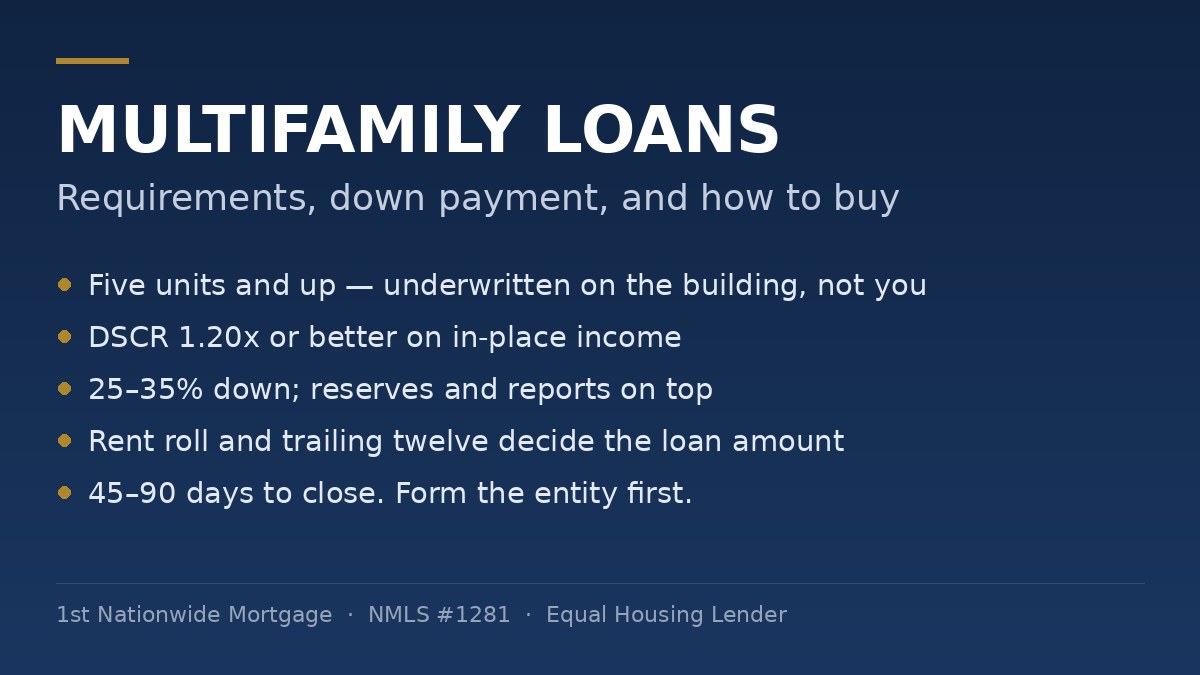
A multifamily loan is commercial financing secured by a residential building of five or more units, underwritten on the property’s income rather than yours. The ratio that decides it is DSCR — net operating income divided by annual debt service.
One to four units is residential. Five and up is multifamily. That single unit of difference moves the file to a different desk with different rules, and the full list of what changes is in commercial loans vs residential loans .
The practical version: on a residential file the lender is underwriting you. On a multifamily file the lender is underwriting the building, and you are the backup.
What are the requirements for a multifamily loan?
Most lenders want DSCR at or above 1.20x, 25 to 35 percent down, several months of debt service in liquid reserves after closing, and a documented income history on the property. The sponsor needs credit and some track record. The entity needs to exist before closing.
| Requirement | What lenders typically want |
|---|---|
| Units | 5 or more (1–4 is residential financing) |
| DSCR | 1.20x or better on in-place income |
| Down payment | 25–35% of purchase price |
| Reserves | Several months of debt service, liquid, post-close |
| Vesting | LLC or other entity, often single-purpose |
| Term structure | 5 or 10 years fixed, 20–25 year amortization, balloon |
| Appraisal | Income approach with a cap rate; comps support only |
| Third-party reports | Phase I environmental, property condition report |
| Documentation | Current rent roll, trailing 12 months operating statements, leases, estoppels |
| Close | 45–90 days |
Notice what is not on that list. No tax returns, no W-2s, no debt-to-income ratio. Those belong to residential underwriting.
DSCR is the whole conversation
DSCR is net operating income divided by annual debt service. At 1.20x the property throws off twenty percent more cash than the debt payment requires.
NOI is where files go wrong. Buyers hand me a seller’s pro forma with vacancy at three percent, no management fee, and repairs at a number nobody has ever actually spent. Underwriting replaces all of it with market assumptions — real vacancy, a management fee whether you self-manage or not, and a replacement reserve per door. The pro forma DSCR was 1.35x. The underwritten DSCR is 1.08x. The loan amount drops, and the buyer is short on the down payment two weeks before closing.
Run the numbers with a management fee in them before you write the offer.
How long are multifamily loans?
The term and the amortization are two different numbers, and that trips up almost everyone coming from residential. Expect a five or ten year fixed period amortized over twenty to twenty-five years, with a balloon at the end of the fixed period. You refinance or sell at the balloon.
A thirty-year fixed that fully pays itself off is a residential convention. It does not usually carry over to commercial, and that is not a trick being played on you — it is how the commercial market prices duration.
What that means practically: a refinance event is built into the deal from day one, and the plan for it is part of underwriting. “What is your exit?” is a normal question on a multifamily file and a strange one on a house.
Longer fixed periods exist on some agency multifamily debt. They come with their own program requirements and their own prepayment structures, and they are a different conversation from the one most five-to-twenty-unit buyers are having.
How much can I borrow on a multifamily property?
The loan amount is an output, not an input. It falls out of whichever constraint binds first — DSCR or LTV — and on most files it is DSCR.
Work it backwards. Take the property’s net operating income after underwriting adjusts it, divide by the DSCR the lender wants, and that gives you the annual debt service the property supports. The loan amount is whatever principal produces that payment at the term and amortization on offer. Then LTV caps it: if that number exceeds the lender’s LTV against appraised value, LTV wins and the loan comes down.
Which is why two identical buildings at the same price get different loans, and why a seller’s asking price has very little to do with what the property will finance. Bring the trailing twelve and you can run this before you write an offer.
Sample Scenario
24-Unit Garden-Style Apartments, Tampa FL
- Purchase price: $3,200,000
- Down payment: $800,000 (25%)
- Loan amount: $2,400,000
- Gross rents: $38,400/month
- Operating expenses: $12,800/month (33% OER)
- NOI: $25,600/month × 12 = $307,200 annual
- Debt service (30-yr amort): $181,800/yr
- DSCR: $307,200 ÷ $181,800 = 1.69
Illustration only. Pricing and debt service come out of the file — see the rate section below.
What is the minimum down payment for a multifamily property?
Plan on 25 to 35 percent of purchase price. The exact figure falls out of DSCR and LTV together, not from a published minimum.
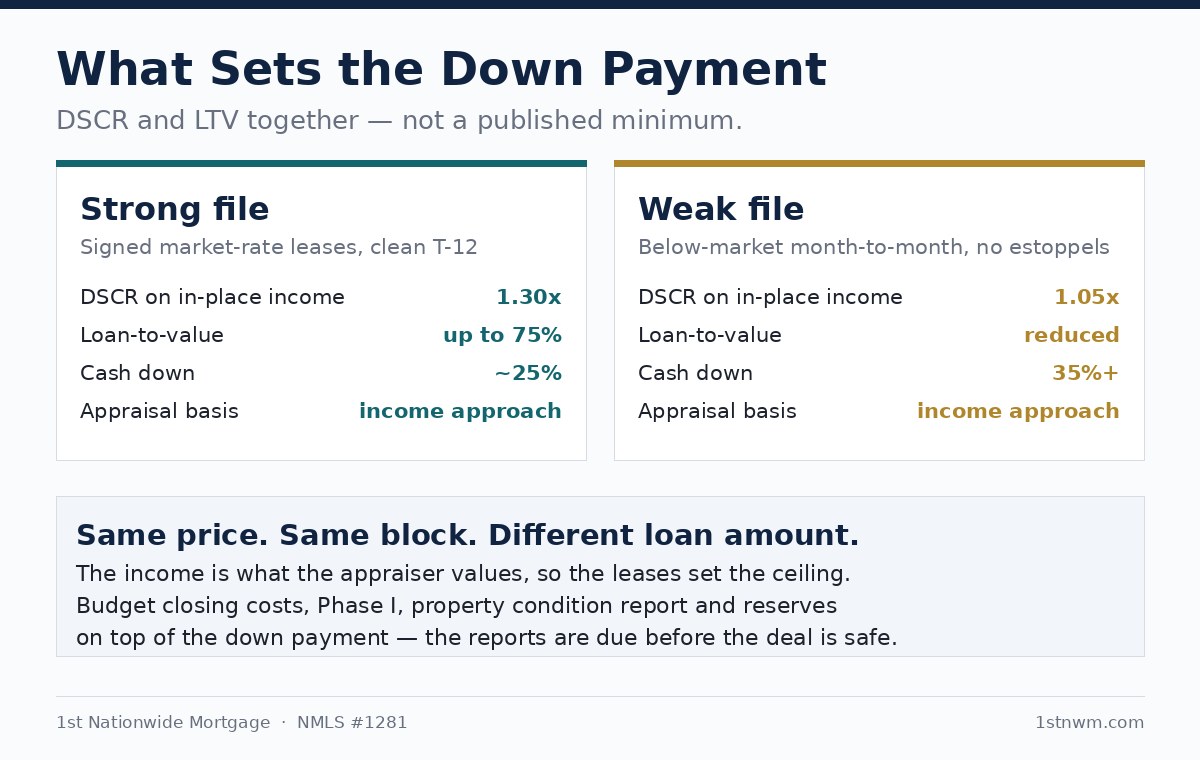
Two buildings at the same price do not get the same loan. One with signed market-rate leases and clean operating statements supports a higher loan amount than one with below-market month-to-month tenancies and no estoppels, because the income is what is being valued. Below-market leases in place appraise low even in a strong market.
And the down payment is not the whole cash requirement. Budget closing costs, the third-party reports, and reserves on top of it. The reports alone are real money and they are due early, before you know whether the deal survives.
Can you get 100% financing for a multifamily property?
Not from one lender on a purchase. But the question behind the question is usually “how little of my own cash can I put in,” and that has real answers — six of them, and they stack.
| Structure | How it works | What it realistically covers |
|---|---|---|
| Seller carry | Seller holds a note behind the senior loan | 10–20% of price, when the seller wants the installment-sale tax treatment |
| Equity partner / JV | Partner funds the gap for a share of the deal | Most or all of the down payment — you trade ownership, not debt |
| Cross-collateralization | Senior lender takes additional security in a property you already own | Reduces or replaces cash down if the other asset has equity |
| Cash-out on an existing asset | Refinance a property you own, use proceeds as the down payment | The full down payment, if the equity is there |
| Loan assumption | Take over the seller’s existing debt in place | Can leave a very small gap when the existing loan is near the purchase price |
| 1031 exchange | Roll proceeds from a sold property into this one | The whole equity piece, on the exchange timeline |
Stack two or three of those and a sponsor is frequently in at ten to fifteen percent of their own money. That is the honest version of “no money down,” and it is achievable.
Two conditions on all of it. The senior lender underwrites the entire capital stack, including the piece you were planning not to mention — an undisclosed second is an event of default on most loan documents, so you disclose it and structure it properly. And the property still has to carry the combined debt. A seller carry that pushes DSCR under 1.00x does not get approved just because the cash worked out.
Where it falls apart: the gap funding is usually more expensive than the senior debt and it shortens your runway to the balloon. Model the combined payment, not the first one.
If someone is advertising true no-money-down apartment buildings with no partner and no carry, read what they are actually selling. It is usually a course.
How do you buy an apartment building?
Form the entity first, get qualified against the property’s real numbers, then order the third-party reports early because they set the timeline.
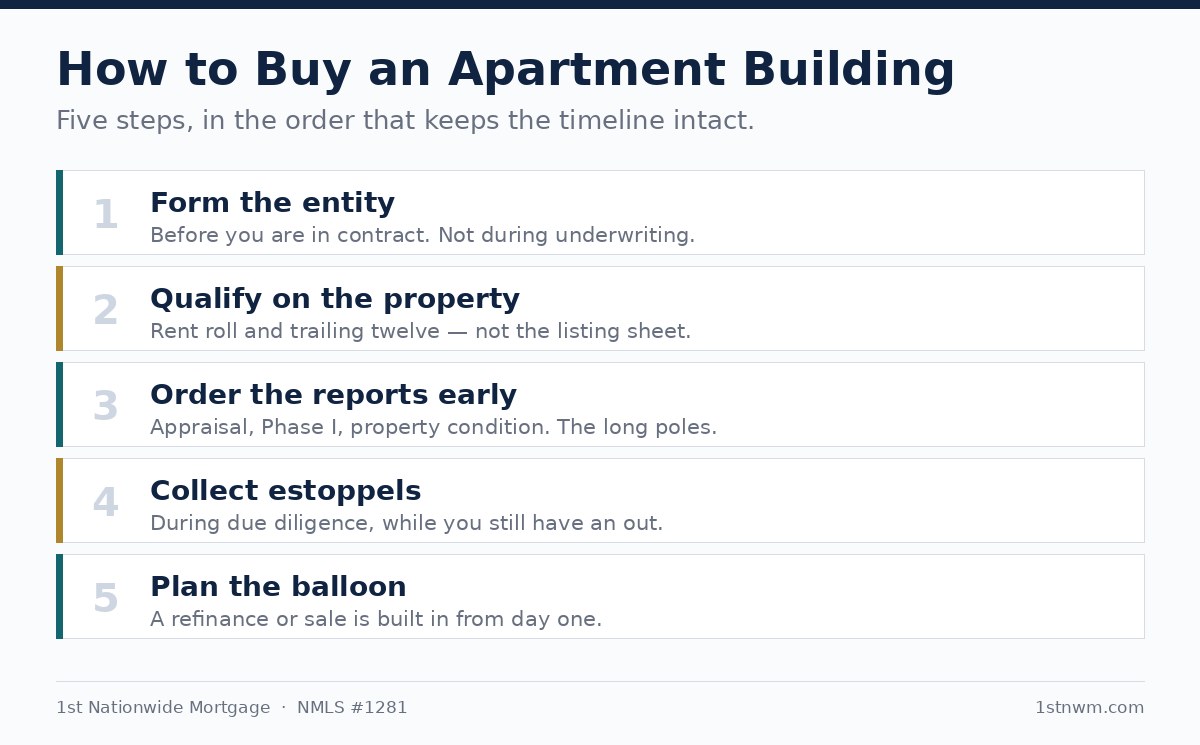
1. Form the entity before you are in contract. An LLC formed during underwriting is a closing delay, and on a commercial purchase a delay costs real money. Title, insurance, and the personal guarantee all attach to the entity.
2. Get qualified on the property, not the pitch. Bring the rent roll and the trailing twelve. A lender who quotes you off a listing sheet is guessing and you will find out in week four.
3. Order the appraisal, Phase I, and property condition report immediately. These are the long poles. On anything that was ever a gas station, a dry cleaner, or light industrial, budget for a Phase II.
4. Collect estoppels during due diligence. A tenant estoppel confirms what the lease says is what the tenant believes. Sloppy month-to-month tenancies with no estoppels are an appraisal problem and a repricing risk.
5. Plan the balloon now. A five or ten year fixed period amortized over twenty to twenty-five means a refinance or sale is built into the deal from day one. “What is your exit?” is a normal question on a multifamily file.
What do lenders look at on a multifamily file?
The leases first. Then the operating statements, the DSCR that comes out of them, LTV, the sponsor’s credit and experience, liquidity after closing, and the physical condition of the building.
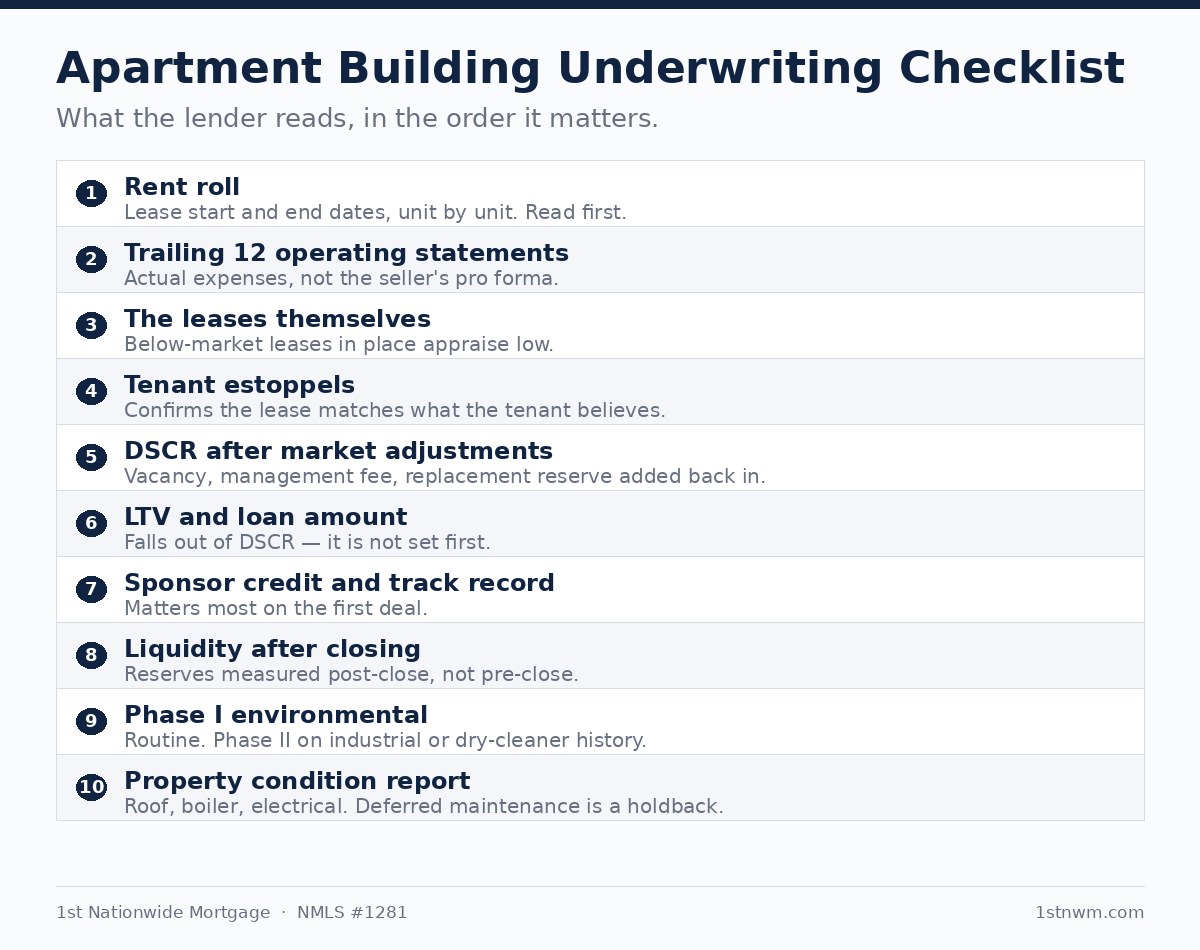
Deferred maintenance shows up either as a holdback or as a smaller loan. A roof with two years left in it is a number in the file whether anyone says so out loud. Same with a boiler, same with electrical on a 1920s building.
Sponsor experience matters more than people expect on the first deal and less than they fear after the second. A first-time buyer with liquidity and a clean building gets financed. A first-time buyer with a thin reserve position and a value-add plan that depends on raising rents thirty percent gets a harder look, because the plan is the repayment source.
Can you get a multifamily loan without tax returns?
Yes, and it is the normal structure rather than a special product. No-doc and light-doc financing qualifies on the rent roll and operating statements.
This matters more than it sounds. An experienced operator’s returns often show heavy depreciation and almost no taxable income — the returns make a successful investor look broke. A property-level file skips that problem.
The same logic drives DSCR loans on one to four unit investment property , and the DSCR requirements guide walks the ratios in detail. For self-employed borrowers buying a primary residence instead of an investment, bank statement loans qualify on deposits.
What about rates?
I do not publish rate figures for multifamily or commercial financing, and any lender quoting you one before seeing the rent roll and the leases is making it up.
What actually drives multifamily pricing: DSCR, LTV, term and fixed period, recourse versus non-recourse, property class and condition, and the sponsor’s experience and liquidity. Observed wholesale ranges live on the non-QM rate index .
The term that costs more than rate on most of these deals is the prepayment structure — yield maintenance, defeasance, or a step-down over the fixed period. On a building you might sell inside five years, the prepay matters more than a modest difference in rate ever will. Price the exit, not just the entry.
Mixed use, and where it lands
A building that is part commercial and part residential gets classified on the split between the two, and lenders do not draw the line in the same place. Mostly apartments over one storefront may get residential-style treatment from some lenders. More commercial square footage than residential is financed as commercial.
In between is genuinely in between, and the classification can swing the down payment, the term, and the vesting. Price a mixed-use file with more than one lender before assuming anything. Same building, two different loans, depending on whose box it lands in.
For buildings with a heavier industrial or flex component, that is a different product — see industrial financing . For a purchase that needs to close before the permanent loan can be underwritten, bridge financing is the usual answer, and value-add or reposition deals typically start on hard money or bridge-to-perm before refinancing into permanent debt once the property is stabilized.
What to bring to the first conversation
- Current rent roll, with lease start and end dates
- Trailing twelve months of operating statements
- The leases themselves, or at least the terms
- Purchase contract if you are in one
- A liquidity figure that is real after closing, not before
- Your plan for the balloon
With those six things you get an actual answer instead of a range. Without them, every lender you call will quote you a number that changes the moment underwriting sees the file, and you will think the business is dishonest when the real problem was that nobody had the documents.
Bring the rent roll. Everything else follows from it.
Related Commercial Products
- Commercial Loans Hub — Full overview across all commercial property types
- Mixed-Use Loans — Residential + commercial combo buildings
- Office Loans — Multi-tenant and medical office buildings
- Retail Loans — Strip centers, NNN single-tenant, and shopping centers
- Industrial Loans — Warehouse, flex, and last-mile logistics
- Self-Storage Loans — Storage facility acquisitions and cash-out
- DSCR Loans — 1–4 unit residential rentals (jumbo and multi-unit variations)
- NONI Investment Loans — Premium 1–4 unit residential investor loan up to $5M
1st Nationwide Mortgage, NMLS 1281. Commercial multi-family loans subject to property, sponsor, and market underwriting. LTV and DSCR vary by loan size, property type, and investor quality. Not all applicants or properties will qualify.
Related reading
Frequently Asked Questions
For smaller properties of 5 to 20 units, many lenders accept first-time multi-family buyers with a strong single-family rental track record. For larger properties and for non-recourse, expect to demonstrate comparable operating experience, liquidity often around 10 percent of the loan amount, and net worth requirements.
Buying or refinancing a five-plus unit building? Call (833) 350-9185 or start an application .
For illustration only. Not a commitment to lend. Rates and terms subject to change and qualification. 1st Nationwide Mortgage Corporation, NMLS #1281. Equal Housing Lender.
Ready to Get Started?
Talk to a licensed loan officer about your options — no obligation.