
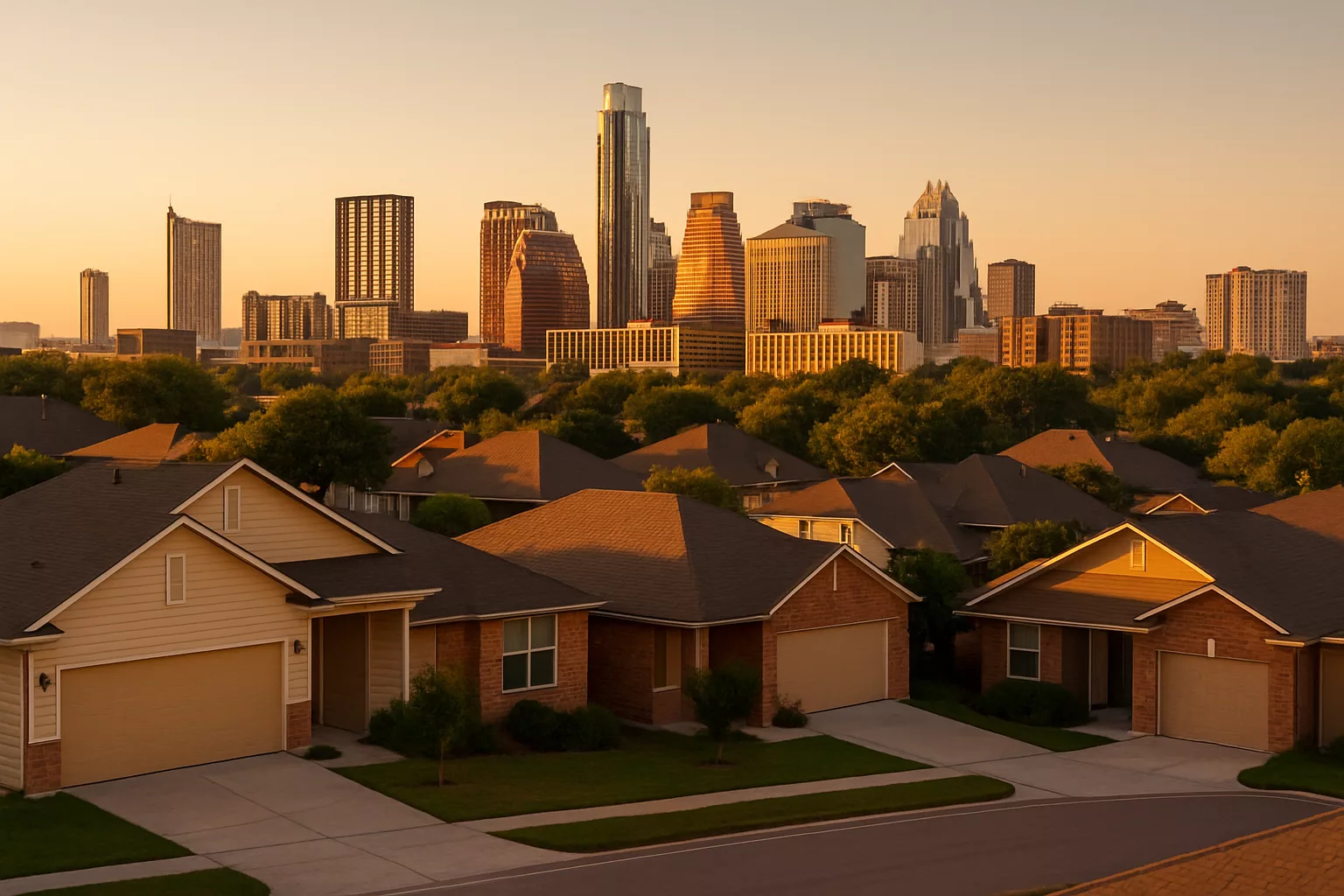
Texas DSCR Loans for Real Estate Investors
Texas is the second-largest rental investment market in the country, and the growth engine hasn’t stalled. Dallas-Fort Worth’s corporate relocation pipeline (Toyota, Charles Schwab, Caterpillar, Tesla, and dozens more) keeps filling apartments and rental homes.
Houston’s energy sector and massive medical center support a diverse tenant base. San Antonio and Austin continue absorbing population growth — Austin from tech, San Antonio from military and healthcare.
No state income tax, business-friendly regulations, and a cost of living below coastal markets: that’s why investors keep buying here. DSCR loans make it possible to finance multiple Texas rentals without ever producing a tax return.
Check DSCR Eligibility Talk to a Loan Specialist — (833) 350-9185New to DSCR? The short version: the property’s rent qualifies the loan — no tax returns, no DTI. Full guide to how DSCR loans work →
How Texas Investors Use DSCR Loans
Single-family rentals in DFW suburbs. Frisco, McKinney, Allen, Plano, Arlington, and Fort Worth suburbs have massive tenant pools. Corporate transplants, young families, and workers at the Amazon, Tesla, and Toyota facilities in the area need rental housing. See Dallas-Fort Worth investor loans →
Properties in the $250K–$400K range with rents of $2,000–$2,800/month hit DSCR targets consistently.
Houston portfolio building. Houston’s sprawl means there’s always inventory. Katy, Pearland, Sugar Land, Cypress, and Spring offer suburban single-family rentals with good rental demand from energy sector workers, medical center employees, and Port of Houston logistics staff.
Houston’s affordability keeps entry prices manageable.
Austin and San Antonio short-term rentals. Austin’s event economy (SXSW, ACL, Formula 1, UT football) and San Antonio’s tourism (River Walk, military families visiting Fort Sam Houston and Lackland) create short-term rental demand. DSCR loans accept projected STR income for properties in these markets.
Scaling past conventional limits. Texas is a volume market. Investors who want 10, 20, or 50 properties need financing that scales. DSCR loans have no property count limit and no DTI — each property is underwritten on its own rental income.
Texas DSCR Loan Requirements
- DSCR ratio: 1.0+ preferred; some programs allow down to 0.75
- Credit score: 640 minimum; better rates at 700+
- Down payment: 15–25%
- Property types: Single-family, 2–4 unit, condo, townhome, short-term rental
- No tax returns, W-2s, or pay stubs
- Close in personal name or LLC
- No limit on number of financed properties
Texas Rules That Shape DSCR Deals
Cash-out on investment property is simpler than most Texas borrowers expect. Texas’s famous home-equity restrictions (the Article XVI, Section 50(a)(6) rules — 80% LTV cap, 12-day waiting period, once-per-year limits) apply to homesteads, not investment property. A DSCR cash-out refinance on a Texas rental follows standard investor guidelines, so pulling equity out of a Dallas or Houston rental to fund the next purchase is a normal, repeatable play here.
Property taxes are the DSCR variable to respect. With no state income tax, Texas counties lean on property tax — often 1.8–2.5% of assessed value. That flows straight into PITIA and compresses the ratio, so a property that would clear 1.25 DSCR in a low-tax state may sit near 1.0 here. Strong Texas rents usually absorb it, but underwrite with the real county tax number, not a national average.
Gulf Coast insurance belongs in the math early. Windstorm exposure in Houston, Corpus Christi, and Galveston-area STRs raises insurance costs materially versus inland metros — another PITIA line that moves the ratio. Inland markets (DFW, San Antonio, Austin) don’t carry the same load.
DSCR Is a Non-QM Loan — What That Means for Texas Investors
DSCR loans are non-QM loans (non-Qualified Mortgage). Non-QM financing sits outside Fannie Mae / Freddie Mac conforming guidelines, which require full-doc income verification (tax returns, W-2s, DTI calculation). DSCR qualifies on the property’s rental income alone — a different underwriting track built specifically for investors.
For Texas investors building rental portfolios, non-QM financing is usually the only path that works:
- Conforming DTI doesn’t scale. Once you own multiple rentals, Fannie/Freddie rules cap you at 10 financed properties and require rental income to show on two years of tax returns — depreciation commonly makes that income negative on paper. Non-QM DSCR bypasses this entirely.
- LLC vesting is standard practice in Texas. Texas investors almost always hold investment properties in LLCs for liability and asset protection. Conforming loans don’t allow LLC vesting; non-QM DSCR does.
- Self-employed borrowers with optimized returns. Texas has no state income tax, which encourages aggressive federal tax optimization. Most Texas investor-borrowers have 1040s that understate actual income. Non-QM skips that entirely.
- Texas-based non-QM lending has matured. Rates have tightened meaningfully. Today, non-QM DSCR rates run roughly 0.75-1.50 points above conforming — usually a worthwhile trade for the qualification flexibility.
Our Texas DSCR program is the non-QM loan most Texas investors come to us for. We also offer bank statement non-QM for self-employed borrowers buying primaries or investments based on deposits, and NONI investment loans as a premium tier of DSCR for high-balance investors.
DSCR Loan vs. Conventional Investment Loan
DSCR loans are property-based. No personal income docs, no DTI, LLC vesting from closing, no property count cap. Texas investors building large portfolios across DFW, Houston, and San Antonio use DSCR loans as their primary financing tool.
Conventional investment loans require tax returns, W-2s, DTI within guidelines, personal name only, and max 10 financed properties. Rates can be slightly lower on the first few properties, but the structure doesn’t support the kind of volume that Texas markets reward.
Frequently Asked Questions
Texas has high property tax rates — typically 1.8–2.5% of assessed value depending on the county. This increases the PITIA and can lower DSCR ratios compared to lower-tax states.
The key is factoring property taxes into your analysis upfront. Despite the tax burden, Texas rents are strong enough that many properties still hit 1.0+ DSCR with adequate down payment.
Yes. Austin short-term rental regulations have changed in recent years, but properties with valid STR licenses or those in unincorporated areas outside Austin city limits can still operate as short-term rentals.
Lenders accept projected STR income for DSCR qualification. Make sure the property’s STR status is confirmed before making an offer.
Houston and San Antonio metros generally produce the best ratios because purchase prices are lower relative to rents. DFW works well too, especially in suburbs outside the most competitive price brackets.
Austin is trickier — prices are higher, so you may need more down payment to hit target DSCR levels. El Paso and Lubbock are lower-profile markets with favorable rent-to-price ratios.
No. There’s no property count cap. This is one of the biggest differences between DSCR and conventional financing.
Whether you’re buying property #3 or property #30, each deal is evaluated on its own rental income.
Yes. 2–4 unit properties are eligible. Combined rental income from all units is used for the DSCR calculation.
Multi-unit properties in Houston, San Antonio, and DFW often produce strong ratios because the combined rents meaningfully exceed the mortgage payment.
Related Programs in Texas
- Texas Bank Statement Loans — Self-employed? Qualify using bank deposits.
- No-Income Mortgages — Asset-based and no-doc options.
- All Texas Mortgage Programs →
Texas residents: see our Texas licensing and complaint notice .
Get Started
Ready to invest in Texas rental property? Call us at (833) 350-9185 or check eligibility .
Related reading
- DSCR cash-out refinance: seasoning and ratio rules
- DSCR prepayment penalties: which structure to pick
Ready to Get Started?
Talk to a licensed loan officer about your options — no obligation.
Texas Licensing Details
- Company
- 1st NWM Corporation
- NMLS #
- 1437886
- License Type
- Savings & Mortgage Lending
- License #
- SML #1437886
- Corporate Address
- 100 Spectrum Center Dr #900, Irvine, CA 92618
- Complaint Hotline
- 1-877-276-5550
Required State Disclosures
CONSUMERS WISHING TO FILE A COMPLAINT AGAINST A MORTGAGE COMPANY OR RESIDENTIAL MORTGAGE LOAN ORIGINATOR LICENSED IN TEXAS, OR TO FILE A CLAIM AGAINST A RESIDENTIAL MORTGAGE LOAN ORIGINATOR LICENSED IN TEXAS SHOULD SEND A COMPLETED COMPLAINT FORM OR CLAIM APPLICATION TO THE DEPARTMENT OF SAVINGS AND MORTGAGE LENDING (SML): 2601 N. LAMAR BLVD., SUITE 201, AUSTIN, TEXAS 78705; TEL: 1-877-276-5550. INFORMATION AND FORMS ARE AVAILABLE ON SML's WEBSITE: SML.TEXAS.GOV.