
A veteran called me about a house in Vista. He had used a VA loan in 2014, sold that place in 2021, and his agent told him he was done. One and done, she said. Go conventional.
She was wrong, and he almost put 20 percent down on a house he could have bought with nothing.
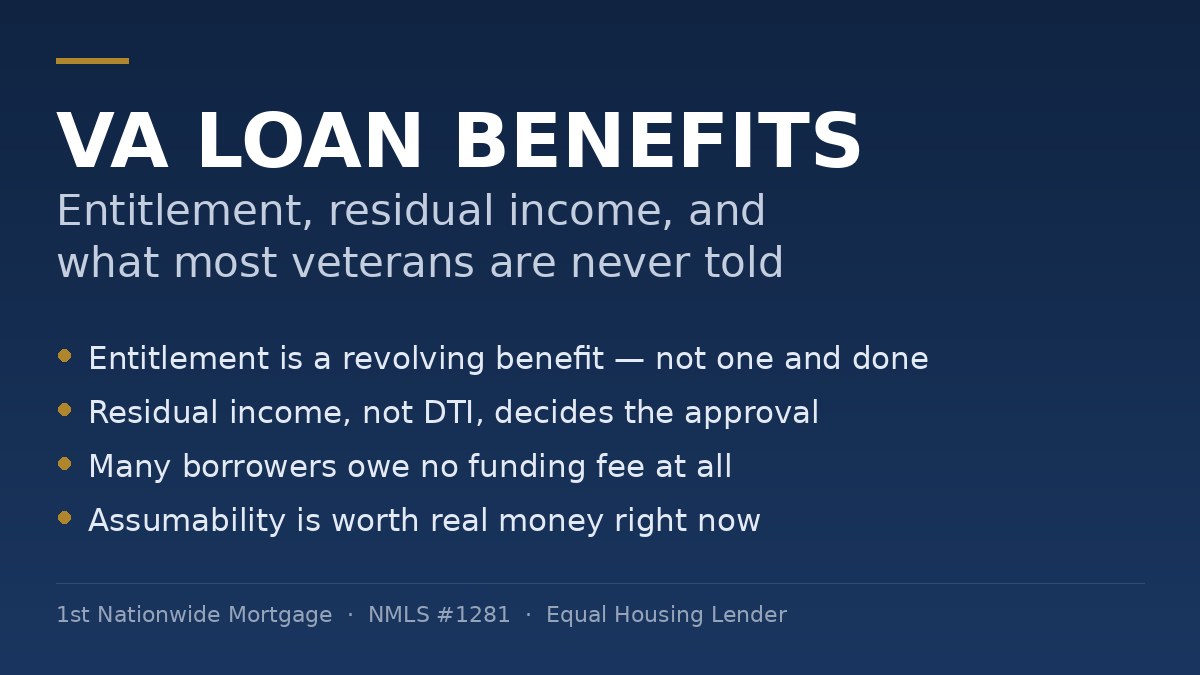
That call is not unusual. The VA home loan is the strongest financing available to anyone who qualifies for it, and it is also the loan surrounded by the most bad information. Most of what gets written about it stops at “no down payment, no mortgage insurance” and quits. Those two things are real. They are also the least interesting part of the program.
Here is what actually matters.
Can you use a VA loan more than once?
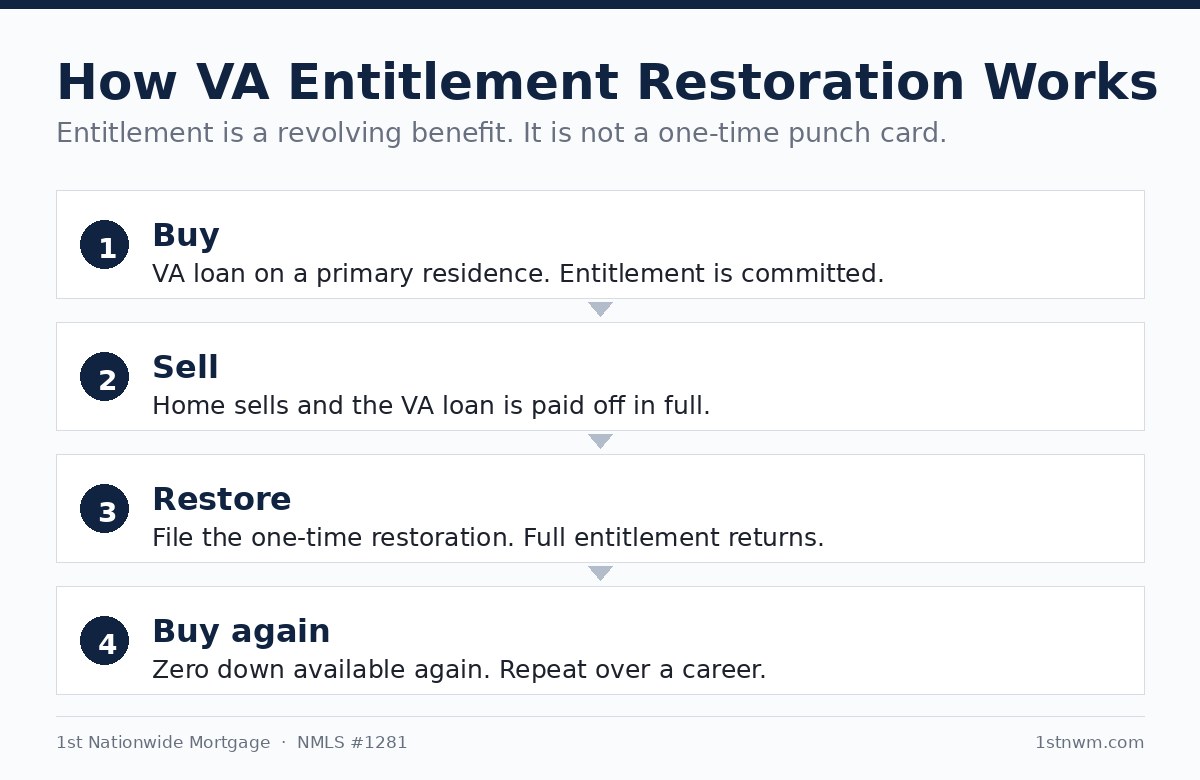
Yes. VA entitlement is a revolving benefit, not a punch card. Sell the home, pay off the VA loan, file a one-time restoration, and your full entitlement comes back. Veterans do this repeatedly over a career.
This is the single most expensive misunderstanding in the program.
Entitlement is the amount VA guarantees to the lender on your behalf. Basic entitlement is $36,000, with a bonus tier stacked on top of it. What matters is that it recycles.
You can also keep the first house and buy a second. That is second-tier entitlement, and it works, but the math changes. Part of your entitlement is still sitting on house number one, so the guarantee available for house number two is smaller. A down payment usually enters the picture. It is often still a better deal than conventional, and almost nobody runs the numbers because they assume the door is closed.
The veteran in Vista bought with zero down. He had sold and paid off the first loan five years earlier. Restoration took a form.
Is there a maximum VA loan amount?
For a veteran with full entitlement, no. There is no VA-imposed ceiling. What you qualify for and what the appraisal supports are the constraints, the same as any other loan.
County loan limits stopped applying to full-entitlement borrowers on January 1, 2020, under the Blue Water Navy Vietnam Veterans Act. That change is six years old and I still get asked whether a $1.2 million purchase is possible on a VA loan.
Limits still apply when you are using partial entitlement — the second-house scenario above. That distinction gets flattened in most articles into “VA loans have limits,” which has been wrong for years. In markets like San Diego, Denver, Seattle, and Austin, where a median house cleared the old county caps a long time ago, that single misunderstanding pushes qualified veterans into conventional financing they did not need.
Residual income is the underwriting rule nobody explains
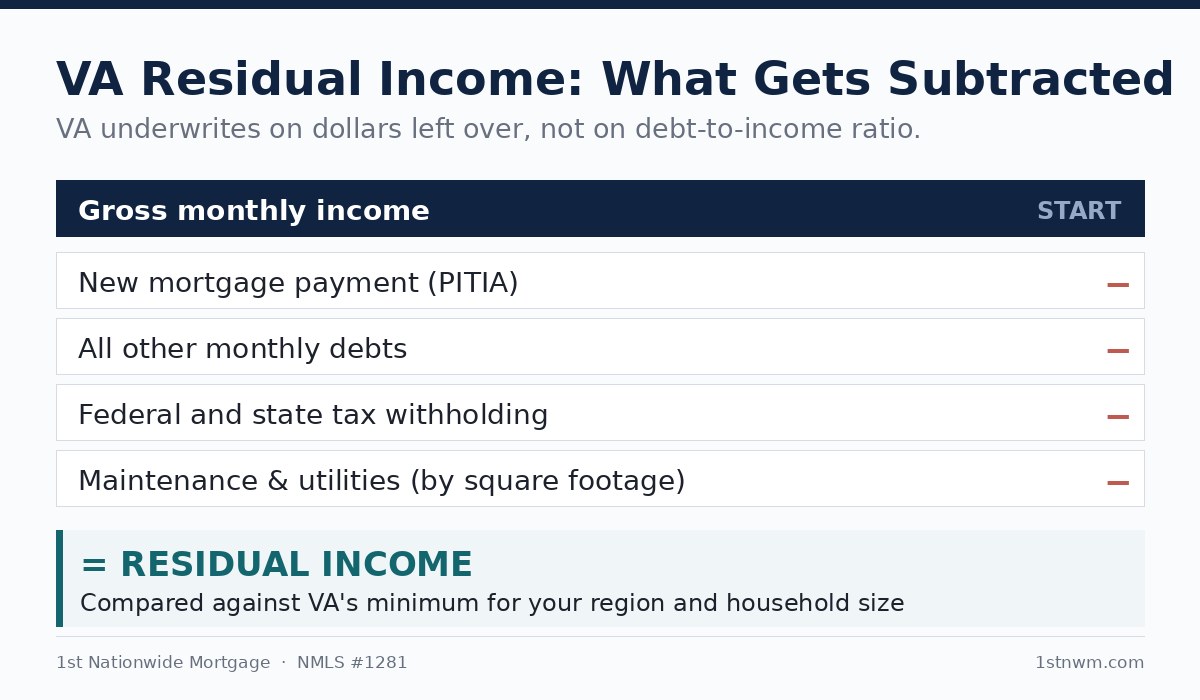
VA does not underwrite primarily on debt-to-income. It underwrites on residual income: the dollars left over every month after the new mortgage payment, every other debt, federal and state tax withholding, and a maintenance-and-utilities figure calculated from the square footage of the house. VA publishes minimums by region and by household size.
This matters in both directions.
It is why a veteran at 52 percent DTI gets an approval that would be dead on a conventional file. Strong income, few consumer debts, plenty left at the end of the month. VA looks at the actual dollars remaining, not the ratio.
It is also why a marginal file fails even though the ratio looked fine. Five people in the household, high-cost region, a payment that leaves $900 in residual against a requirement above that. Declined. The ratio never told you.
If a loan officer has never used the words residual income with you, they have not underwritten a VA loan recently.
The funding fee, and who does not pay it
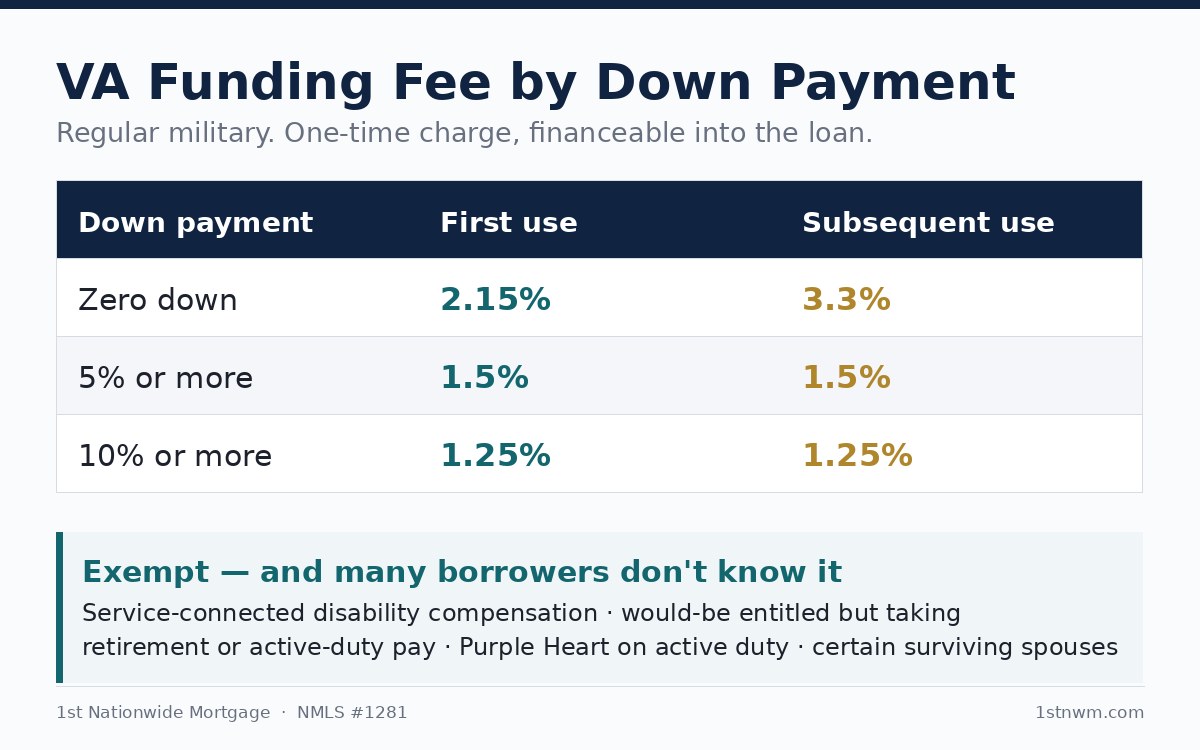
The funding fee replaces mortgage insurance. It is a one-time charge, financeable into the loan, and it scales with down payment and whether this is a first or subsequent use.
For regular military:
| Down payment | First use | Subsequent use |
|---|---|---|
| Zero down | 2.15% | 3.3% |
| 5% or more | 1.5% | 1.5% |
| 10% or more | 1.25% | 1.25% |
On a $600,000 purchase with nothing down, first use, that is $12,900 added to the loan.
The part that gets missed: a large number of borrowers owe none of it.
Exempt are veterans receiving VA compensation for a service-connected disability, veterans who would be entitled to that compensation but are taking retirement or active-duty pay instead, Purple Heart recipients on active duty, and certain surviving spouses. The exemption appears on the Certificate of Eligibility.
I have seen the fee financed into a loan for a borrower who was exempt and did not know it, because nobody pulled the COE until late and nobody read it when it arrived. That is $12,900 of somebody’s equity gone to a clerical failure.
Pull the COE first. Read it.
Assumability is worth real money right now
A VA loan can be assumed by a qualified buyer, who takes over the existing balance at the existing rate.
In a flat-rate market this is a footnote. It is not a footnote now. A seller carrying a loan originated a few years back holds something a buyer cannot get anywhere else, and it belongs in the listing.
Two things the seller has to handle. Get a release of liability, so the debt is no longer theirs. And get a substitution of entitlement where the buyer is also a veteran using their own. Skip the second and the seller’s entitlement stays attached to a house they sold, which blocks the next VA purchase until that loan is paid off. I have watched that discovery happen at the worst possible moment.
The property has to pass, not just the borrower
VA has Minimum Property Requirements, and the appraisal checks them. Safe, sound, sanitary. Working systems, no active roof leak, no peeling paint on a pre-1978 house, adequate access.
This is where VA purchases die in competitive markets, and the reason some listing agents steer against VA offers. Fairly or not.
There is also Tidewater. When an appraiser is heading in below the contract price, VA gives the parties a narrow window to submit supporting comps before the value is finalized. Most agents have never heard of it. It is a real chance to save a deal and it closes fast, so somebody has to be watching the file.
IRRRL and cash-out
Two refinance paths.
The IRRRL — Interest Rate Reduction Refinance Loan — is the streamline. No appraisal in most cases, no income documentation in most cases, reduced funding fee. Existing VA loan to new VA loan, lower rate. About as clean as refinancing gets.
VA cash-out goes higher on LTV than most conventional cash-out options. Full appraisal, full documentation, funding fee applies unless exempt.
Whether we can do this where you are
VA is consumer, owner-occupied lending, so our coverage for it is narrower than it is for investment-property programs. Worth a one-minute phone call rather than an assumption in either direction.
If you are buying investment property instead of a primary residence, that is a different conversation and a different set of programs. DSCR and investor financing qualify on the property’s rent rather than your income — the DSCR requirements guide walks the ratios. Bank statement loans qualify self-employed borrowers on deposits instead of tax returns, and the requirements guide covers what underwriting actually looks at. None of them is a substitute for a VA loan when you are eligible for one. Nothing is.
More on the program itself on our VA home loans page .
The short version
Use it. Use it again. Check whether you owe the funding fee before anyone finances it into your balance. Ask what your residual income looks like, and if the answer is a blank stare, call someone else.
The benefit was earned. It is worth knowing what is actually in it.
Questions about your entitlement, or whether a prior VA loan is still in the way? Call (833) 350-9185 or start an application .
For illustration only. Not a commitment to lend. Rates and terms subject to change and qualification. 1st Nationwide Mortgage Corporation, NMLS #1281. Equal Housing Lender.