
A borrower called me about a fourplex in Sugar Land. He had financed one the year before, conventional, 25% down, and he wanted to do the same thing on a five-unit two streets over. Same street, same tenants, same rent per door.
I told him the down payment was going up, the term was changing, and he would be signing in the name of an LLC.
He thought I was upselling him. I was not. One unit moved him from residential to commercial, and almost every term on the loan changed with it.
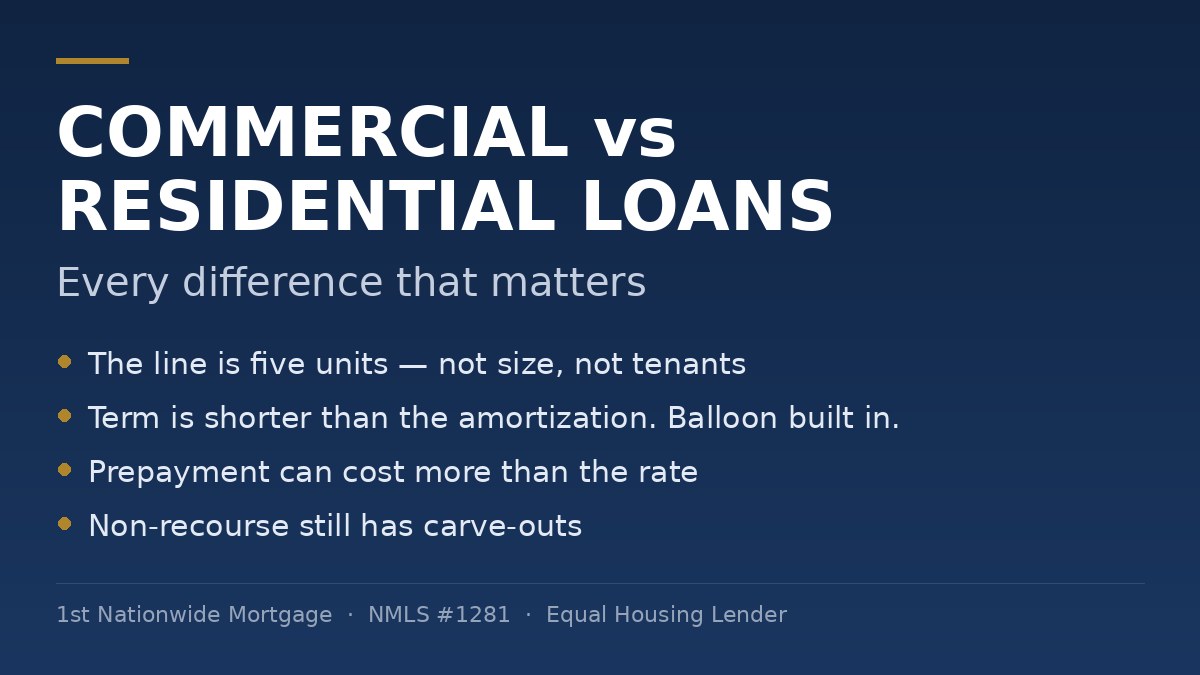
That line — four units versus five — is the cleanest place to start, because everything else follows from which side of it you are on.
What is the main difference between a commercial loan and a residential loan?
A residential mortgage underwrites you. Personal income, tax returns, W-2s or a P&L, measured against a debt-to-income ratio. A commercial loan underwrites the building. Net operating income against debt service, measured as DSCR. You are the backup, not the case.
That inversion drives everything below. Once the property is the borrower in substance, the lender starts caring about things no residential underwriter ever asks about: the rent roll, the lease terms, the tenant mix, whether the roof has ten years left in it, and whether anything was ever spilled on the ground.
Is a 5-unit building commercial or residential?
Commercial. The line sits at five units, and it is not negotiable.
One to four units is residential financing. That includes owner-occupied conventional, FHA, and VA — a buyer can live in one unit of a fourplex and finance the whole building on consumer terms. Five units and up is commercial, underwritten on the property’s income, regardless of who lives in it.
People assume the line is about size, or about whether the tenants are families. It is neither. It is a unit count, and it moves the file to a different desk with different rules.
The term is shorter than the amortization
This is the structural difference that surprises residential borrowers most.
A residential mortgage is usually a 30-year fixed, fully amortizing. You make 360 payments and you own it.
A commercial loan typically has a fixed period shorter than the amortization schedule — five or ten years fixed, amortized over twenty or twenty-five, with a balloon at the end of the fixed period. At the balloon you refinance or you sell.
That is not a trick. It is how the commercial market prices duration. But it means a commercial borrower has a refinance event built into the deal from day one, and the plan for that event is part of underwriting. “What is your exit?” is a normal question on a commercial file and a strange one on a residential file.
Prepayment is where the real money hides
Most consumer mortgages have limited or no prepayment penalty. Commercial loans commonly have real ones:
- Yield maintenance — you make the lender whole on the interest it expected to earn
- Defeasance — you substitute a portfolio of securities for the collateral, common in securitized debt
- Step-down — a declining percentage over the fixed period, often something like 5-4-3-2-1
Borrowers read the rate and skim the prepay. On a property you might sell or refinance inside the fixed period, the prepayment structure can cost more than a modest difference in rate ever would. Price the exit, not just the entry.
I do not publish rate figures for commercial or bridge financing, and any lender quoting you one before seeing the rent roll and the leases is guessing. What drives commercial pricing is DSCR, LTV, term, recourse, property type, and the sponsor’s experience. Observed wholesale ranges live on our non-QM rate index .
Non-recourse does not mean no liability
Residential mortgages are full recourse in most states, with foreclosure practice varying.
Commercial financing offers non-recourse on many deals, which sounds like the lender’s only remedy is the building. Then you read the carve-outs.
Bad-boy carve-outs convert a non-recourse loan to full recourse if triggered. The usual list: fraud or material misrepresentation, misapplication of rents or insurance proceeds, unauthorized transfer or additional encumbrance, environmental misrepresentation, voluntary bankruptcy filing.
None of those are things an honest operator does by accident. But they are real, they are in every non-recourse document I have seen, and “non-recourse” gets sold as if it means nothing can reach you personally. It does not mean that.
You will sign as an entity
Residential loans are typically taken in personal name. Commercial loans are typically vested in an LLC or other entity, often one formed for that property alone.
This is not a formality — it changes title, insurance, the tax filing, and what a personal guarantee actually attaches to. Form the entity before you are in contract, not during underwriting. An entity formed at the last minute is a closing delay, and on a commercial purchase the delay is expensive.
The appraisal asks a different question
A residential appraiser asks what comparable homes sold for.
A commercial appraiser asks what the income stream is worth, using the income approach and a capitalization rate, with sales comparison as support rather than the main event. Two identical buildings with different rent rolls appraise differently. A building with below-market leases in place appraises low even in a hot market, because the income is what is being valued.
Practical consequence: on a commercial deal, your leases are part of your value. A seller with sloppy month-to-month tenancies and no estoppels hands you an appraisal problem.
Commercial files also frequently require a Phase I environmental site assessment and a property condition report — neither of which exists in residential lending. On anything that was ever a gas station, a dry cleaner, or light industrial, budget for a Phase II too.
Down payment and reserves
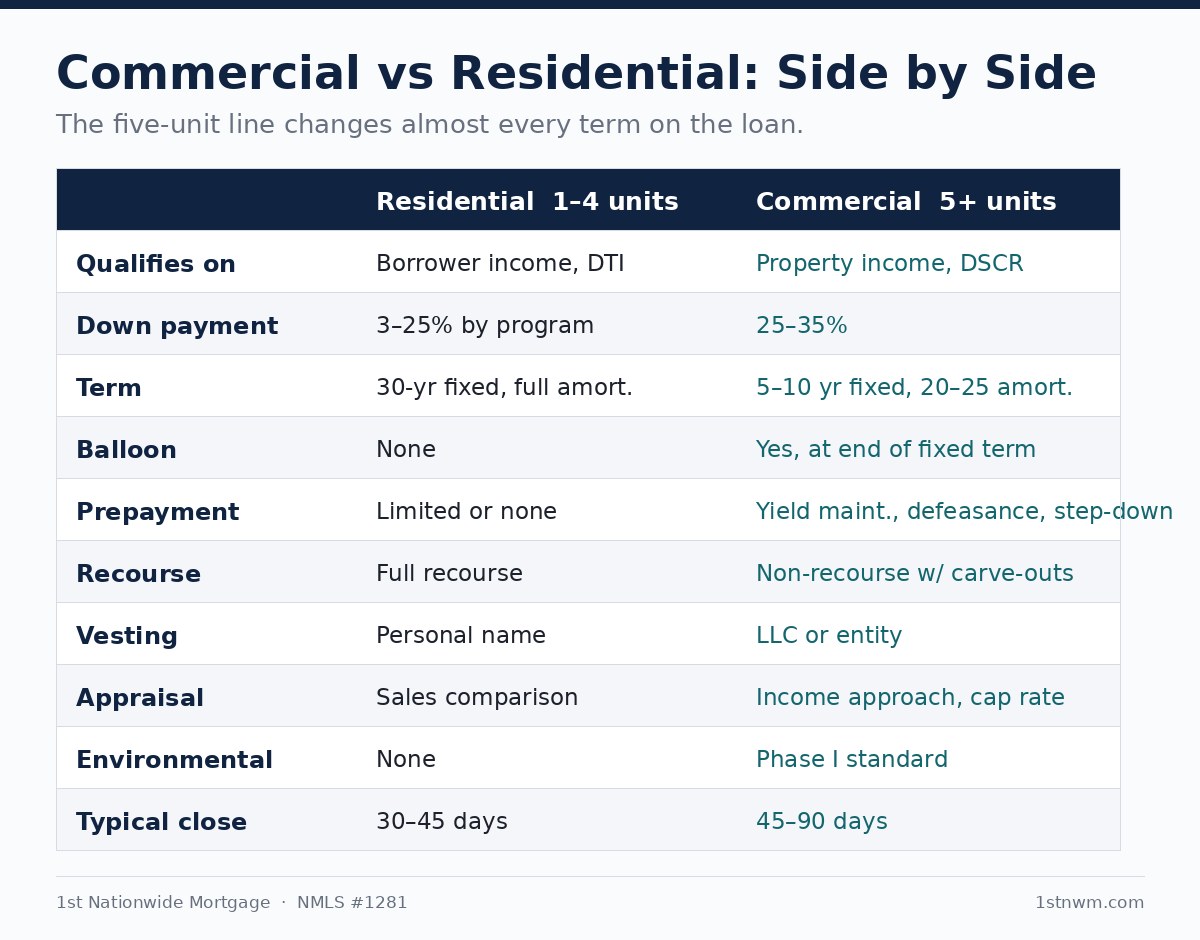
| Residential (1–4 units) | Commercial (5+ units) | |
|---|---|---|
| Qualifies on | Borrower income, DTI | Property income, DSCR |
| Typical down payment | 3–25% depending on program | 25–35% |
| Term | 30-year fixed, fully amortizing | 5–10 year fixed, 20–25 year amortization, balloon |
| Prepayment | Limited or none | Yield maintenance, defeasance, or step-down |
| Recourse | Full recourse | Non-recourse available, with carve-outs |
| Vesting | Personal name | LLC or entity |
| Appraisal | Sales comparison | Income approach, cap rate |
| Environmental | None | Phase I standard |
| Typical close | 30–45 days | 45–90 days |
Reserves are heavier on commercial too — lenders commonly want months of debt service in liquid reserves after closing, plus escrows for taxes, insurance, and sometimes replacement reserves for capital items.
Where mixed use sits
This is the question I get most, and the honest answer is that it depends on the split — and that lenders do not draw the line in the same place.
A building that is mostly apartments with one storefront on the ground floor may get residential-style treatment from some lenders. A property with more commercial square footage than residential is financed as commercial. In between is genuinely in between, and the classification can swing the down payment, the term, and the vesting.
Which means a mixed-use file is worth shopping to more than one lender before you assume anything about the terms. The same building can be two different loans depending on whose box it lands in. That is not a reason to avoid mixed use — it is a reason not to plan the deal around the first quote.
Can you get a commercial loan without tax returns?
Yes. No-doc and light-doc commercial financing qualifies on the rent roll and operating statements instead of personal tax returns.
This matters more than it sounds. An experienced investor’s returns often show heavy depreciation and little taxable income — the returns make a successful operator look broke. A DSCR-style commercial file skips that problem by looking at the property. Credit and reserves still count, and so does track record.
The same logic drives DSCR loans on 1–4 unit investment property , and the DSCR requirements guide walks the ratios. For self-employed borrowers buying a primary residence rather than an investment, bank statement loans qualify on deposits — the requirements guide covers what underwriting actually looks at.
What this means if you are crossing over
If you have financed houses and you are buying your first five-unit or your first commercial building, the things that will catch you are not the rate:
- The balloon, and what your plan is for it
- The prepayment structure, if there is any chance you sell early
- The entity, formed before you are in contract
- The leases, because they are your appraisal
- The environmental report, on anything with an industrial past
None of it is hard. It is just a different loan, and the residential instincts you built over three or four purchases do not carry over cleanly.
Bring the rent roll and the trailing twelve months of operating statements to the first conversation and you will get a real answer instead of a range.
Questions on a specific property — multifamily, mixed use, or commercial? Call (833) 350-9185 or start an application .
For illustration only. Not a commitment to lend. Rates and terms subject to change and qualification. 1st Nationwide Mortgage Corporation, NMLS #1281. Equal Housing Lender.