
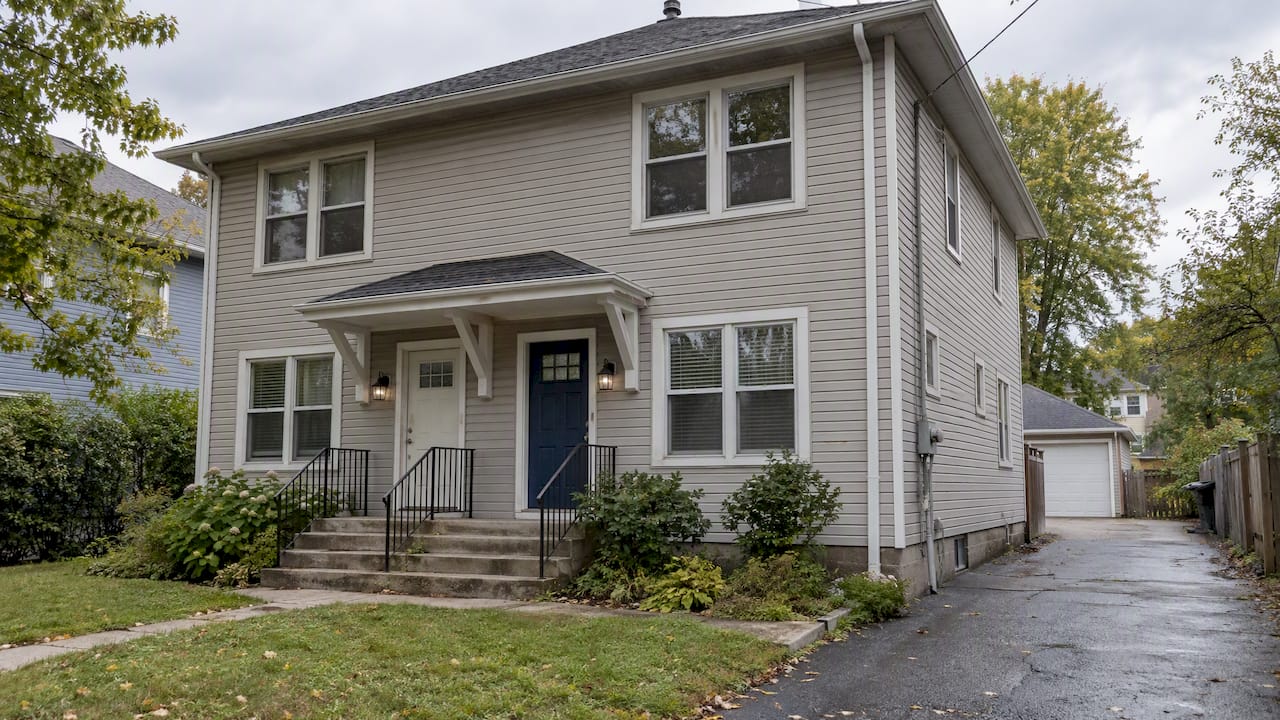
A DSCR loan lets you finance a duplex based on what the property earns, not on your tax returns or W-2s. The lender adds up the rent from both units, compares it to the monthly cost of owning the building, and approves or declines the file on that ratio, plus your credit and down payment. The duplex must be an investment property. You cannot use a DSCR loan to buy a duplex you plan to live in.
This guide walks through how the math works for two units, what lenders look at beyond the ratio, and how to prepare a file that moves smoothly.
TL;DR
- DSCR stands for debt service coverage ratio: the property’s income measured against its debt payments. For a duplex, you combine the rent from both units.
- DSCR financing is for non-owner-occupied investment properties only. It is not an option for a primary residence, including a duplex where you live in one side.
- At our company, DSCR loans start at a 640 minimum credit score, and the borrower’s personal income is not part of the qualification.
- A ratio at or above 1.0 means the rent covers the payment. Many lenders want a cushion above that, and a higher ratio can widen your options.
- Expect an appraisal, a lease or market rent analysis, proof of down payment and reserves, and an entity such as an LLC if you want to hold title that way.
Table of Contents
- What a DSCR loan is, in plain terms
- Why duplexes fit DSCR financing well
- How the DSCR is calculated for a duplex
- How lenders count rent from both units
- Can you live in one unit of the duplex?
- What else the lender reviews
- Advantages and drawbacks of financing a duplex this way
- Step by step: preparing a duplex DSCR file
- Our perspective
- Start a duplex scenario with our team
- FAQ
- Sources
What a DSCR loan is, in plain terms
Debt service coverage ratio is an old underwriting tool from income-property lending. Federal regulator guidance describes it as net operating income divided by total debt service, and notes that the property’s own cash flow is generally the primary source of repayment on income-property loans (OCC/OTS Examination Handbook 210, Appendix A). A DSCR mortgage for investors applies that same logic to a one-to-four unit rental.
The practical difference from a conventional loan is the question being asked. A conventional underwriter asks whether you, personally, earn enough. A DSCR underwriter asks whether the building earns enough. That is why investors with strong portfolios but complicated tax returns, or with several financed properties already, often look at this route. Our DSCR loans page covers the program overview, and the sections below focus on the duplex.
Why duplexes fit DSCR financing well
A duplex gives you two rent streams under one roof and one loan. If one unit sits empty between tenants, the other still pays. For ratio purposes, that diversification is a real help: the lender is looking at combined income against a single mortgage payment.
A duplex also sits inside the one-to-four unit category that DSCR programs are built around. Properties of five units or more usually move into commercial underwriting, which is a different process. If you are looking at a larger building, see our commercial real estate loans.
How the DSCR is calculated for a duplex
The formula has two sides.
Income side: the total monthly rent from both units.
Obligation side: the full monthly cost of the loan, which for most DSCR programs means principal, interest, property taxes, hazard insurance and any association dues. Lenders abbreviate this as PITIA.
Divide the first by the second.

A worked example
This is an illustration, not a quote or a prediction of what any property will produce.
| Item | Monthly amount |
|---|---|
| Unit A rent | $1,800 |
| Unit B rent | $1,700 |
| Total rent | $3,500 |
| Principal and interest | $2,050 |
| Property taxes | $520 |
| Insurance | $230 |
| Total PITIA | $2,800 |
$3,500 divided by $2,800 gives a DSCR of 1.25. The rent covers the payment with a cushion.
Now change one number. If Unit B rents for $1,300 instead, total rent is $3,100 and the ratio becomes about 1.11. The file may still work, but the lender may price or structure it differently, and you may need a larger down payment to bring the payment down. Our DSCR ratio calculation guide shows more examples and what lenders count.
What the ratio numbers mean
- Below 1.0: the rent does not cover the payment. Some programs consider these files with compensating strengths, but options narrow.
- 1.0: break-even on paper.
- Above 1.0: rent exceeds the payment. Many investors target a comfortable margin.
A question that comes up often is whether a DSCR of 1.7 is good. It is strong. It means rent is well above the obligation, which generally helps a file. The federal handbook cited above calls a 1.31 ratio in its own example good and acceptable, and says savings associations generally require a stabilized ratio of 1.20 or higher, with possible exceptions. That is guidance written for banks examining income-property loans, not a rule for every private lending program, but it shows why 1.2 and above has long been treated as a healthy range.
How lenders count rent from both units
Each unit’s rent is evaluated and then the two are added together. The income figure usually comes from one of two places.
- A signed lease. If both units are leased, the lease amounts are the starting point. Lenders commonly want a current lease and may compare it to market rent.
- Market rent from the appraisal. For a vacant unit, or a purchase where leases are not yet in place, the appraiser can supply a market rent estimate for each unit. Lenders commonly use that figure instead.
One practical point: if one unit is leased and the other is vacant, the file is typically built on a mix of the lease for one side and the appraiser’s market rent for the other. Get the lease paperwork organized early, and check that lease terms match what you tell the loan officer. A lease well above the neighborhood’s market rent can draw questions.
Operating costs and vacancy
The federal handbook says lenders should verify income and expense data, allow for reasonable vacancy and collection loss, and include typical management fees even when the owner manages the property personally (OCC/OTS Examination Handbook 210, Appendix A). That is the traditional net-operating-income approach. Many DSCR programs simplify it by measuring gross rent against the PITIA payment, and the exact method depends on the program, so ask your loan officer which one your file will use.
Either way, do your own homework on costs the ratio may not show: repairs, turnover, utilities you cover, and the days a unit sits empty. If the building is vacant at any stretch during a renovation or between tenants, check how that affects your hazard coverage. Standard homeowners-style policies often limit coverage on empty properties, and an independent agent can explain vacancy permit insurance options before the gap becomes a problem.

Can you live in one unit of the duplex?
No. DSCR loans are for non-owner-occupied investment properties. If you plan to occupy one unit as your home, a DSCR loan is the wrong product, and you should not structure a file that suggests otherwise.
Owner-occupied duplex purchases run through consumer mortgage programs, which have their own income documentation, occupancy rules and, for some products, different eligibility by state. We offer those programs only in select states, and availability depends on where the property is. If you want to house-hack a duplex, talk with a loan officer about which route is open in your state before you make an offer. If you are self-employed and want to buy an owner-occupied home, our bank statement loans may be worth a look where available.
For investors, the opposite is also true: a DSCR loan is meant for a property you will rent to tenants, so plan your use of both units accordingly.
What else the lender reviews
The ratio is the headline, but it is not the whole file. Underwriting still looks at several things.
Credit score
Our DSCR program starts at a 640 minimum credit score. Scores below 640 are reviewed case by case, and we do not advertise a lower floor. Higher scores generally give you more flexibility in structuring the loan.
Down payment and reserves
Investment property loans usually need more down than owner-occupied purchases. Lenders also commonly ask you to show liquid reserves, meaning money left over after closing that could cover payments if a unit stays empty. Your loan officer can tell you what applies to your scenario.
Appraisal
Yes, an appraisal is typically required for a duplex DSCR loan. It sets the property value that the loan amount is measured against, and for a duplex it often includes a rent schedule that supports the income figure. The federal handbook likewise lists appraisal, credit history, net worth and business experience among the underwriting requirements for income-property loans (OCC/OTS Examination Handbook 210, Appendix A).
Entity and experience
DSCR financing works with LLCs, and there is no limit on the number of financed properties. If you hold title in an entity, have your formation documents ready. Some programs ask about investment experience, so a short summary of your current rentals helps.
Prepayment terms
Some investor loans carry a prepayment penalty. Availability and structure vary by state and are restricted in several. Prepayment terms are confirmed at application, so ask about them before you commit, especially if you plan to sell or refinance within a few years.
Advantages and drawbacks of financing a duplex this way
Here is how to weigh the choice.
Where it helps
- Qualification centers on the property, so write-offs and complex returns do not reduce your qualifying income.
- Two rent streams support the ratio and spread the vacancy risk.
- You can use an LLC and keep adding properties without a cap on the number of financed ones.
- The process is generally lighter on personal income documentation.
What to plan for
- Investor loans often have different pricing and down payment expectations than owner-occupied loans, so run numbers before you fall in love with a building.
- The ratio depends on rent. Underpriced or unstable rent weakens the file, so verify local rents with comparable listings.
- A DSCR loan funds a finished, rentable property. It is not construction financing. If the duplex needs heavy work first, short-term options such as rehab loans or bridge loans may be the first step, with a DSCR refinance afterward once it is stabilized.
The best way to handle the planning items is early: price the loan with realistic rent, an honest insurance and tax estimate, and a cash cushion.
Step by step: preparing a duplex DSCR file
- Estimate rent for each unit. Use comparable listings in the same neighborhood, then confirm with the appraisal’s rent schedule.
- Gather the property costs. Get the tax bill, an insurance quote and any association dues so the PITIA is accurate rather than guessed.
- Run the ratio. Divide total rent by PITIA. Try a conservative rent figure too and see whether the ratio still holds.
- Check your credit. Confirm you are at or above the 640 minimum and clear up any errors before applying.
- Line up down payment and reserves. Be ready to document where the funds sit.
- Prepare entity documents. If buying through an LLC, have the operating agreement and EIN ready.
- Collect leases. Current leases, rent rolls and proof of deposits speed up underwriting on a property that is already rented.
- Talk to a loan officer before you sign a purchase contract. A short scenario review can catch a ratio problem while you can still negotiate.
Our perspective
We see the same pattern with duplex buyers. The property can be a good one, yet the file stalls because the investor leads with personal income, tax returns and write-offs instead of what the building produces. A DSCR loan is built for the opposite approach.
Our focus is non-QM and alternative income programs for self-employed borrowers and investors, and our loan officers handle files personally rather than passing them through a call center. For a duplex, that means we look at both units’ rent, the full monthly obligation and your credit and cash position, then help you choose between structures before you are under contract.
Our advice is simple: run the ratio with conservative rent, keep the occupancy rule in mind, and bring your questions to us early. It is much easier to adjust a down payment or loan structure on paper than after an appraisal comes in.
Christopher Arco, NMLS #1281
Start a duplex scenario with our team
If you are buying or refinancing a duplex as a rental, we can review your numbers and walk you through how our DSCR program would look at the property. Our DSCR loans qualify on rental income, not personal income, and work for borrowers using LLCs.
To get started, share the address or the target price, expected rents and your credit range. If you want a deeper look at documents first, read our DSCR loan requirements guide, or visit 1st Nationwide Mortgage to reach a loan officer.
FAQ
Can I use a DSCR loan on a duplex I will live in?
No. DSCR loans are for investment, non-owner-occupied properties only. If you plan to live in one unit, you need a different, owner-occupied program, and availability depends on the state where the property sits.
Do both units count toward the DSCR?
Yes. Lenders generally add the rent from both units, using leases or the appraiser’s market rent, and divide the total by the monthly obligation. A vacant unit is usually counted at market rent from the appraisal.
Is a DSCR of 1.7 good?
It is a strong ratio, because rent is well above the payment. Federal examination guidance describes a 1.31 example as good and says a stabilized 1.20 or higher is generally expected for savings associations. Programs differ, so ask your loan officer about the target for your file.
Is an appraisal required for a duplex DSCR loan?
Typically yes. The appraisal establishes the property’s value and commonly includes a market rent estimate for each unit, which supports the income side of the ratio.
Can a DSCR loan pay for building a duplex?
Generally no. DSCR loans are permanent financing on a finished, rentable property. Construction or major rehab usually needs short-term financing first, followed by a DSCR loan once the units are stabilized.
Sources
- OCC/OTS Examination Handbook 210, Appendix A: Income Property Lending
- Vacancy permit insurance guidance
For illustration only. Not a commitment to lend. NMLS #1281. Equal Housing Lender.