
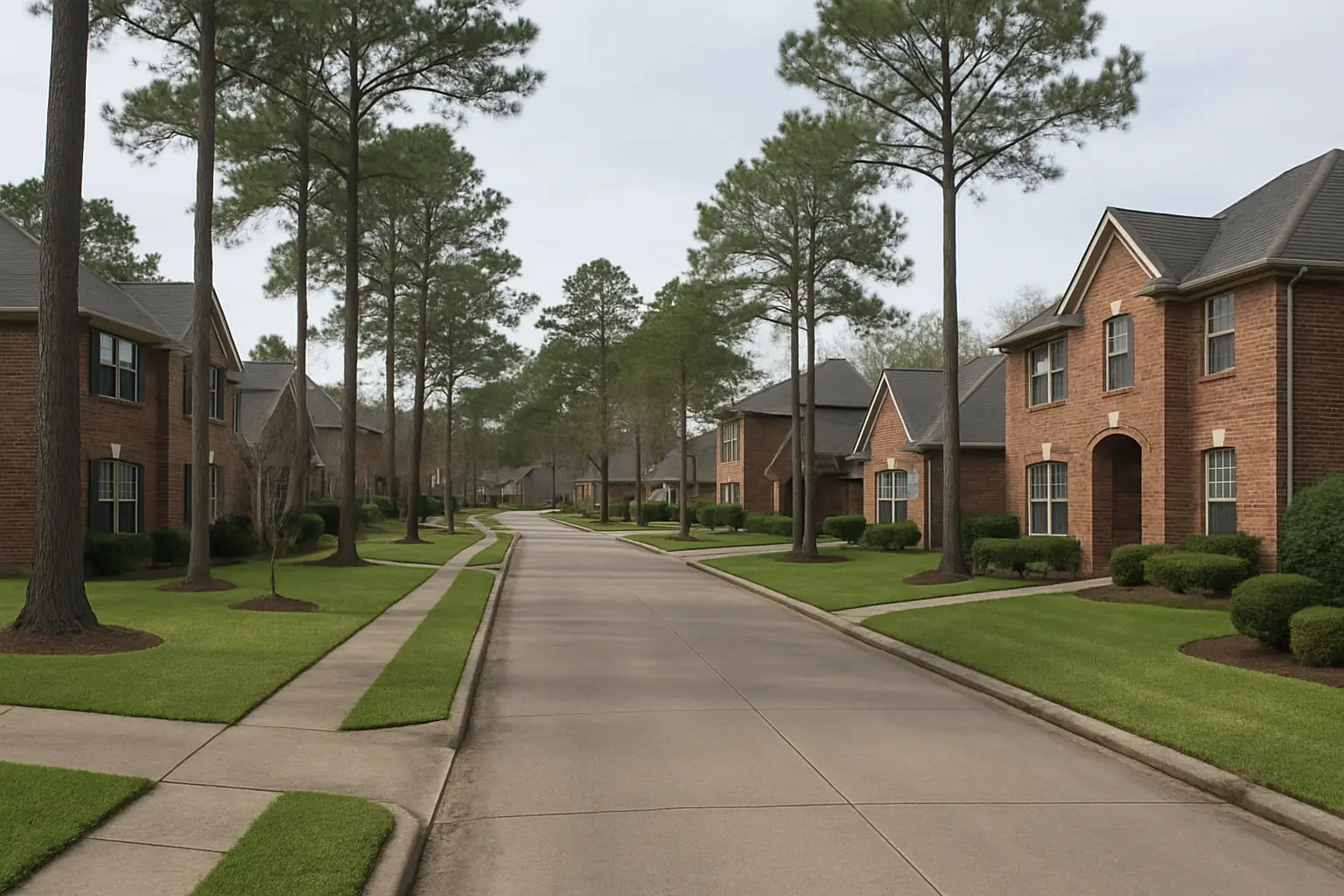
Houston is the largest rental market in Texas and one of the few major metros where the underwriting math still clears on a straightforward single-family purchase. It is also a market where three local rules — an uncapped investor tax assessment, a brand-new short-term rental registration regime, and a land-use system that runs on private deed restrictions instead of zoning — decide whether a deal pencils. Getting those three right is most of the work on a Houston file.
1st NWM Corporation, NMLS #1437886, works the full financing picture in Texas: DSCR and other business-purpose investor programs, plus the consumer side — FHA, VA, USDA, conventional, jumbo, reverse, and Texas down payment assistance.
Talk to a Loan Specialist — (833) 350-9185The tax line is the DSCR, not a footnote
Every DSCR calculation is rent divided by PITIA. In most markets the “T” is a rounding decision. In Harris County it is the variable that decides the file.
Harris County’s median effective property tax rate is 1.49%, with the City of Houston at 1.44% — against a national median of 1.02%. On a $315,000 purchase, that is roughly $378 per month in taxes before insurance. Median rent on a three-bedroom single-family in the metro runs about $1,550. Taxes alone eat a quarter of gross rent.
Here is the part investors get wrong, and it is a matter of statute rather than market conditions.
Texas Tax Code §23.23 caps annual increases in appraised value at 10% — for residence homesteads only. A non-owner-occupied rental has no such cap. When Harris County Appraisal District moves a value, an investment property absorbs the entire move in a single tax year, while the homestead next door absorbs it over several.
The practical consequence: a DSCR calculated on the seller’s tax bill is not a DSCR. A long-held property, or one that carried a homestead exemption under the prior owner, is very likely carrying an artificially suppressed assessment. That exemption does not travel with the property. Reassessment at market, with no cap and no exemption, can move the tax line several hundred dollars a month — and a file that penciled at 1.15 at application can land under 1.00 by the first tax cycle.
The fix is not complicated, it is just discipline: underwrite the tax line off the purchase price at the current combined rate, not off the seller’s prior bill. We do this by default on Houston files. It occasionally kills a deal at application. It kills fewer deals at the first escrow analysis, which is where the expensive version of this surprise happens.
Insurance compounds it. Flood coverage in Harris County runs roughly $1,500–$4,000 per year depending on zone designation and elevation — another $125 to $333 per month. Taxes and insurance together can run $500–$710 monthly on a median-priced Houston rental, which is what has to be cleared before a dollar of debt service counts.
California investors encounter the same underwriting discipline through the opposite mechanism — a single Prop 13 reassessment at closing rather than Texas’s uncapped annual movement. How that plays differently across two Southern California markets: San Diego and Orange County .
Where the yield actually is
Cap rates in the Houston metro spread wide by submarket, and the spread is a straightforward reflection of the same math:
| Submarket | Typical cap rate range |
|---|---|
| Northeast (Aldine, Greenspoint, North Forest) | 6.5–8.5% |
| Southeast (Pasadena, South Houston, Galena Park) | 5.5–7% |
| Southwest (Alief, Sharpstown, Westwood) | 5.5–7% |
| Northwest (Spring, Cypress, Tomball) | 4.5–6% |
| Inner Loop (Montrose, Heights, EaDo, Third Ward) | 3.5–5% |
Metro vacancy sits near 6.5%, modestly above the national single-family figure of about 5.8%. Inner Loop properties rarely debt-service on a DSCR basis at current pricing — they are appreciation plays financed as such. The northeast and southeast submarkets are where DSCR ratios above 1.20 are routinely achievable, and they are also where the tax-reassessment trap is most common, because they hold more long-tenured owner-occupants converting to rentals.
These are illustrative observations drawn from published market commentary, not a valuation opinion on any specific property.
The short-term rental ordinance changes what you are financing
Houston adopted a short-term rental ordinance effective January 1, 2026, with registration opening October 1, 2025. It applies to any dwelling unit — or any portion of one — rented for fewer than 30 consecutive days, including individual units inside apartment and condo buildings.
What it requires:
- A $275.00 non-refundable application fee, plus a City administrative fee ($33.10 for 2025), adjusted annually by CPI
- Owner and property information, emergency contacts, tax documentation, completed training, and a signed authorization form
- Hotel occupancy tax remittance — Airbnb and Vrbo remit on behalf of hosts; on other platforms the host registers directly with Houston First Corporation
- No insurance requirement is imposed by the ordinance itself
What it enforces:
- Operating without registration carries a fine of $100 to $500 per violation, and each day of continued violation is a separate violation
- Registrations can be revoked for qualifying criminal convictions, repeat sound-ordinance violations, or repeat nuisance and building-code violations
- Platforms must remove non-compliant listings within ten business days of City notice
The provision that matters most to a portfolio investor is the cascade: if three or more of an owner’s certificates are revoked within any consecutive 24-month period, the remaining certificates may be revoked as well. One badly managed property does not stay contained to that property.
For underwriting, this reframes what the collateral is. On a short-term rental file, the registration certificate is part of the income-producing asset — an unregistered Houston STR is not a lower-yielding property, it is a property whose stated income is not lawfully producible. We want the certificate number in the file. Where a property is mid-registration, the conservative path is to underwrite the long-term rental number and treat short-term upside as unfinanced.
No zoning means the deed restriction is the rulebook
Houston does not have conventional use-based zoning. Land use is governed instead by private deed restrictions, plat restrictions, and HOA covenants — enforceable, property-specific, and not visible on any municipal zoning map.
This cuts both directions. It is why Houston supports mixed-use infill, garage conversions, and duplex-to-fourplex plays that would require a variance elsewhere. It is also why “the city allows it” is not a complete answer on a Houston file. A subdivision’s deed restrictions can bar short-term rentals, cap occupancy, or prohibit non-owner occupancy outright, and city registration does not override a private covenant.
Before underwriting income from a use, confirm the use is permitted by the instrument that actually governs it. On investor files where the business plan depends on a specific use — STR, room-by-room rental, ADU income — pull and read the restrictions during diligence, not after closing.
Texas closing mechanics
Texas is an attorney-involved closing state with a 24-hour document approval window. That window is real and it is not flexible. Files that reach the closing table with unresolved conditions do not compress the timeline — they move the closing date. Front-loading conditions matters more in Texas than in states with same-day doc flexibility.
Programs that fit Houston files
- DSCR Loans in Houston — investment properties qualified on rental income. Harris County’s uncapped annual reassessment makes honest tax underwriting the first step, not the last.
- Bank Statement Loans in Houston — for Houston’s contractor-dense energy and services sectors, qualified on 12–24 months of deposits rather than tax returns.
- NONI, business-purpose bridge, FHA, VA, USDA, conventional, jumbo, reverse, and Texas down payment assistance are all available on Texas transactions. Contact us to match the right program.
Working a Houston file
The Houston deals that close cleanly share a pattern: taxes underwritten at reassessed market value rather than the seller’s bill, insurance quoted against the actual flood zone rather than a metro average, use rights confirmed against the deed restrictions, and — on short-term rental files — a registration certificate in hand or long-term rent used instead.
Run the numbers with the tax line set honestly and Houston still works at yields most large metros stopped offering. Run them off the seller’s tax bill and the market looks better than it is for about eleven months.
For illustration only. Not a commitment to lend. Rates and terms subject to change and qualification. 1st NWM Corporation, NMLS #1437886. Equal Housing Lender.
Texas residents: see our Texas licensing and complaint notice .
Related reading
Get Started
Whether you’re buying your first home in Katy, refinancing in the Heights, or picking up a rental in Third Ward — we’re ready when you are.
Call (833) 350-9185 to talk through your situation, or check your eligibility to get the process moving.
Talk to a Loan Specialist — (833) 350-9185Ready to Get Started?
Talk to a licensed loan officer about your options — no obligation.
Texas Licensing Details
- Company
- 1st NWM Corporation
- NMLS #
- 1437886
- License Type
- Savings & Mortgage Lending
- License #
- SML #1437886
- Corporate Address
- 100 Spectrum Center Dr #900, Irvine, CA 92618
- Complaint Hotline
- 1-877-276-5550
Required State Disclosures
CONSUMERS WISHING TO FILE A COMPLAINT AGAINST A MORTGAGE COMPANY OR RESIDENTIAL MORTGAGE LOAN ORIGINATOR LICENSED IN TEXAS, OR TO FILE A CLAIM AGAINST A RESIDENTIAL MORTGAGE LOAN ORIGINATOR LICENSED IN TEXAS SHOULD SEND A COMPLETED COMPLAINT FORM OR CLAIM APPLICATION TO THE DEPARTMENT OF SAVINGS AND MORTGAGE LENDING (SML): 2601 N. LAMAR BLVD., SUITE 201, AUSTIN, TEXAS 78705; TEL: 1-877-276-5550. INFORMATION AND FORMS ARE AVAILABLE ON SML's WEBSITE: SML.TEXAS.GOV.