
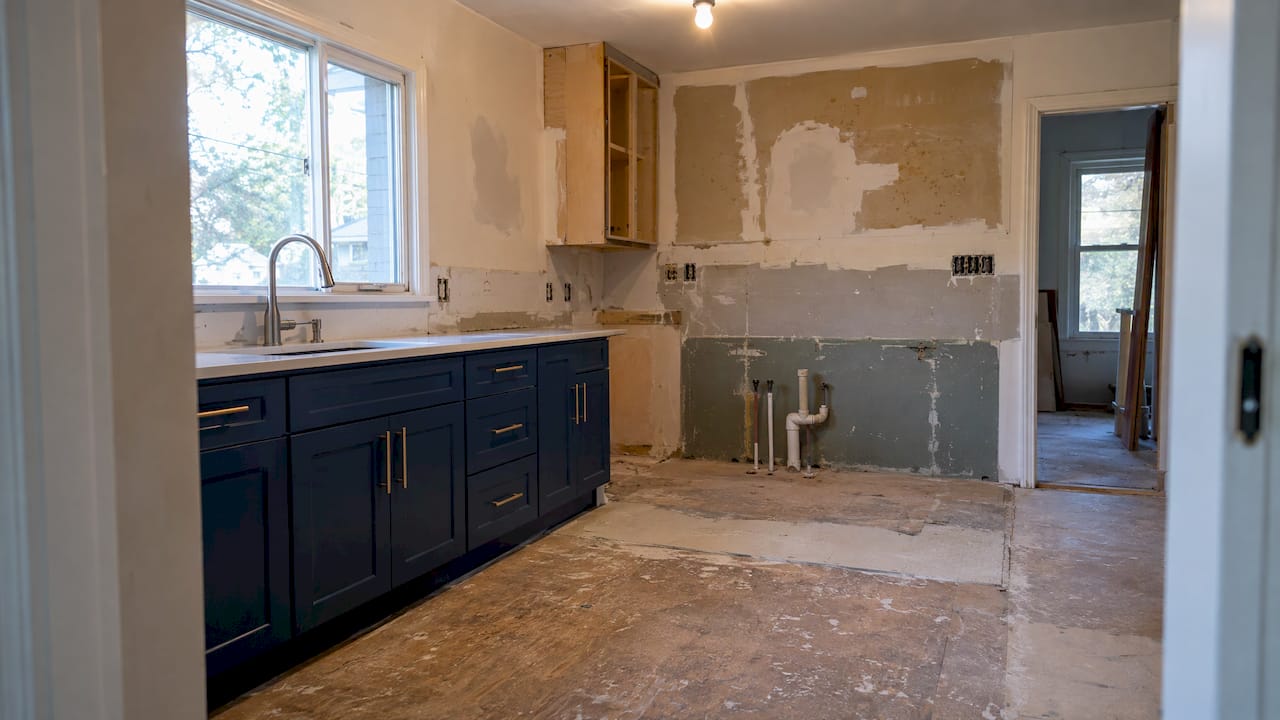
The right rehab loan depends on three things: whether you will live in the property, how you document your income, and how fast the work has to start. Owner-occupants in California, Colorado, Oregon, Washington, Texas and Idaho can look at FHA 203(k) and conventional renovation mortgages. Investors usually need short-term rehab or fix and flip financing, or a rental-income loan once the work is done. We are a direct lender, and we build these loans around self-employed borrowers, investors and foreign nationals whose income does not fit a standard bank checklist.
TL;DR
- A rehab loan bundles the purchase or refinance and the repair budget into one loan, with funds released as work is completed.
- Owner-occupied renovation programs (FHA 203(k), HomeStyle) are available through us in CA, CO, OR, WA, TX and ID. Investment-property rehab financing is available more broadly.
- Draws are paid in stages after inspections, so your contractor schedule and your paperwork matter as much as your credit.
- Self-employed and foreign national borrowers can qualify on bank statements, rental income or asset-based programs instead of tax returns.
- Rates and terms vary by borrower and are confirmed at application. Everything here is illustrative.
Table of Contents
- What a rehab loan actually does
- Rehab loan options for homes you will live in
- Rehab loan options for investors
- Income verification: self-employed, foreign national and high-DTI borrowers
- How rehab loan draws work
- What can disqualify a borrower or property
- Comparing a renovation loan with selling as-is
- How to choose
- Talk to a loan officer about your project
- Our perspective
- FAQ
- Sources
What a rehab loan actually does
A standard mortgage lends against what a house is worth today. A house that needs a new roof, kitchen or foundation work is worth less today than it will be after the repairs, so a normal loan leaves you hunting for separate cash or a second loan.
A rehab or renovation loan fixes that sequence. HUD describes its FHA 203(k) program as a way for buyers to finance a purchase, or for homeowners to refinance, while rolling renovation, repair or remodeling costs into a single loan, with funds based on the appraised value after the proposed improvements. You make one application, one closing and one monthly payment.
The repair money does not arrive in your account. The lender holds it and releases it as work is finished. That is the part most borrowers underestimate, and we cover it below under draws.

Rehab loan options for homes you will live in
If the property is your primary residence and it is in California, Colorado, Oregon, Washington, Texas or Idaho, the main choices are FHA 203(k) and a conventional renovation mortgage such as Fannie Mae’s HomeStyle. Our FHA home loan and loan programs pages show what is available to you.
FHA 203(k): Limited and Standard
Per HUD’s fact sheet, there are two versions:
- Limited 203(k): non-structural work up to $35,000, with no minimum repair cost and an optional consultant.
- Standard 203(k): major rehabilitation with no maximum renovation cost, a $5,000 minimum repair cost and a required FHA-approved 203(k) consultant.
A 203(k) consultant is an independent professional who walks the property, writes up the scope of work and cost estimate, and later inspects the work before each payment. HUD’s program comparison sheet lists 203(k) for one- to four-unit primary residences, with both purchase and refinance options. If you already own and want to fund the work through a refinance, that purchase-and-refinance flexibility is its main advantage. Our types of FHA mortgages page explains how the FHA family fits together.
Fannie Mae HomeStyle
According to the FDIC’s HomeStyle guide, HomeStyle lets you include improvements totaling up to 75% of the as-completed appraised value in a purchase or refinance first mortgage. It has no income limits and a 620 minimum credit score, and it allows primary residences, second homes and one-unit investment properties. Maximum loan-to-value is 97% on a one-unit primary residence. Cash back at closing is not allowed, and the work must be permanently affixed, add value and be completed within 12 months of delivery.
HUD’s comparison sheet notes that the conventional renovation programs are purchase options, while 203(k) covers both purchase and refinance.
Side by side
| Feature | Limited 203(k) | Standard 203(k) | HomeStyle |
|---|---|---|---|
| Scope of work | Non-structural, up to $35,000 | Major rehab, no maximum | Up to 75% of as-completed value |
| Minimum repair cost | None | $5,000 | None stated in the guide |
| Consultant | Optional | Required | Lender manages the process |
| Occupancy | 1-4 unit primary residence | 1-4 unit primary residence | Primary, second home, 1-unit investment |
| Minimum credit score | Set by lender overlay | Set by lender overlay | 620 |
Credit and down payment requirements vary by program and borrower. We confirm them with you at application.
Rehab loan options for investors
Investor rehab is a different product. The goal is usually to buy a distressed property, fix it and either sell or rent it. Traditional renovation mortgages are built around owner-occupants and slow timelines, so most investors use short-term, asset-based financing.
- Rehab loans: our rehab loans for investors fund the purchase and the repair budget for investment properties.
- Fix and flip loans: built for a buy, renovate and resell plan, with speed at closing as the priority. See our fix and flip loans.
- Hard money and bridge loans: short-term loans secured by the property. Our hard money and bridge loan pages explain how they work.
- Commercial loans: for mixed-use or commercial buildings, see commercial real estate loans.
Investor rehab financing is business-purpose lending, so it is available to you in states beyond the six where we offer owner-occupied programs. If you want state detail, we have pages for Connecticut and Delaware rehab loans.
Plan the exit before you borrow
Short-term rehab loans end with a sale or a refinance. If you plan to keep the property as a rental, the natural next step is a DSCR loan. It qualifies the loan on the property’s rental income rather than your personal income, works for LLCs, and has no limit on how many properties you finance. DSCR is for investment, non-owner-occupied property only, and our minimum credit score for it is 640.
Some investor loans carry a prepayment penalty. Whether one is available, and how it is structured, varies by state and is restricted in several. Prepay terms are confirmed at application, so ask about them before you compare offers.
Income verification: self-employed, foreign national and high-DTI borrowers
Most rehab guides assume you have two years of tax returns and W-2s. Many of our borrowers do not.
Self-employed and freelancers. If write-offs lower your reported income, a bank statement loan uses 12 to 24 months of deposits to derive qualifying income instead of tax returns. The standard expense factor on business accounts is 50%, and it can drop to 35-40% with a CPA-certified profit and loss statement. Minimum credit is 620, with 10-20% down. You can estimate your own qualifying income with our bank statement income calculator.
The owner-occupied version is available in CA, CO, OR, WA, TX and ID. For a non-owner-occupied rehab or rental purchase, bank statement financing is available as business-purpose lending in other states too.
Foreign nationals and borrowers with no documentable income. Our NONI investment loans (no income, no asset) are designed for investment property buyers who cannot document income the way a U.S. bank expects.
W-2 borrowers with high debt-to-income ratios. Debt-to-income, or DTI, is your monthly debt payments divided by your monthly income. Agency renovation programs are sensitive to it. If yours is high, ask us about non-QM options at application, where we can review the whole file.

How rehab loan draws work
A draw is a release of renovation funds to pay for completed work. The steps are similar across programs.
- Scope and estimate. Your contractor and, on a Standard 203(k), your consultant prepare a work write-up and cost estimate. HUD’s handbook drafting table says the estimate must state the nature and type of repair and the cost of each work item, split into labor and materials, with lump sums only where reasonable and customary.
- Closing. The seller or your existing mortgage is paid off. The FDIC’s 203(k) guide explains that the remaining funds go into an escrow account and are released as repairs are completed.
- Inspection and payment. On a Standard 203(k), the consultant performs the draw request inspections. Under HomeStyle, Fannie Mae says funds sit in a custodial account and the lender manages all project draws.
- Completion. A final inspection is ordered, the appraiser signs a completion certificate, and under HomeStyle any leftover escrow reduces your unpaid principal balance.
Where draws go wrong
- Contractor cash flow. Contractors who expect large deposits can stall when payments follow inspections. Agree on a payment schedule that matches the draw schedule before you sign.
- Scope changes. A new line item that is not in the approved estimate can delay payment. Change the scope on paper first.
- Sloppy records. Keep invoices, receipts and lien waivers organized by job. If you run the renovation through a business, job-by-job contractor expense tracking makes it easier to show where each draw went.
- No cushion. Overruns are common. Build a contingency into the budget instead of planning to the dollar.
For investor rehab loans, draw schedules and inspection rules are set in your loan terms, which we review with you at application.
What can disqualify a borrower or property
Most rehab denials come from the property and the paperwork, not only from credit. Watch for these.
- The work does not fit the program. Per HUD, Limited 203(k) covers non-structural work up to $35,000, and Standard 203(k) requires at least $5,000 in repairs. A project that falls outside the range needs a different product.
- Property type. HUD’s 203(k) sheet lists single-family homes, two- to four-family units, townhomes, eligible condos (interior improvements only), manufactured homes titled as real estate where the rehab does not affect structural components, and mixed-use properties that are at least 51% residential. Anything outside that list does not qualify.
- Occupancy. 203(k) is for primary residences. A rental or flip needs an investor product.
- Cash-out expectations. HomeStyle does not allow cash back at closing.
- Timeline. HomeStyle work must be completed within 12 months of delivery.
If an owner-occupied program is not the right match, an investor or non-QM program often is, as long as the property is a business-purpose loan.
Comparing a renovation loan with selling as-is
Sometimes the best rehab loan is no rehab. If you own a property in poor condition, weigh the full cost, time and risk of the project against a sale. This renovation costs versus a cash offer guide frames that comparison for Metro Detroit sellers. If you decide the project is worth doing, the options above are the next step.
How to choose
- Will you live there? Yes: FHA 203(k) or HomeStyle in CA, CO, OR, WA, TX or ID. No: investor rehab, fix and flip, hard money or bridge.
- How big is the work? Cosmetic and non-structural under $35,000 points to Limited 203(k). Structural points to Standard 203(k) or HomeStyle.
- How do you document income? Tax returns point to agency programs. Bank statements, rental income or no documentable income point to bank statement, DSCR or NONI.
- What is the exit? Sell: fix and flip. Rent: rehab, then DSCR. Live: 203(k) or HomeStyle.
- How fast must you close? Short-term investor loans prioritize speed.
Talk to a loan officer about your project
We specialize in non-QM and alternative-income mortgage solutions, and a dedicated loan officer personally handles your file rather than a call center. Tell us the property, the scope of work and how you earn your income, and we will help you match it to a program. Start at our loan programs page or contact us.
We are BBB A+ rated. Terms depend on the borrower and property and are confirmed at application.
Our perspective
Most renovation projects that struggle do not fail on the loan. They fail on mismatch: an owner-occupant program used for an investor plan, or a borrower with strong cash flow forced through a tax-return box that hides it.
We start with the file. A self-employed borrower with 24 months of deposits, an investor with a rental-income exit, a foreign national buying an investment property: each has a program that fits, and finding it early saves weeks.
Our loan officers handle your file personally, explain how the structure works, and tell you what the paperwork will require before you commit. That is how we think rehab financing should be done.
Christopher Arco, NMLS #1281
FAQ
What is the difference between a rehab loan and a renovation loan?
The terms are often used interchangeably. Owner-occupants usually say renovation loan for programs like FHA 203(k) or HomeStyle. Investors usually say rehab loan for short-term financing to buy and repair a property for resale or rent.
Can I use a rehab loan for an investment property?
Yes, but the product differs. HomeStyle allows one-unit investment properties, according to the FDIC guide. FHA 203(k) is for primary residences. Investors usually use rehab, fix and flip, hard money or bridge loans.
Can self-employed borrowers get a rehab loan without tax returns?
Often yes. Bank statement programs use 12 to 24 months of deposits to derive income, and DSCR loans qualify on the property’s rental income. Eligibility depends on credit, down payment and the property, and we confirm it at application.
Do rehab loans have prepayment penalties?
Some investor loans do. Availability and structure vary by state and are restricted in several. Prepay terms are confirmed at application.
Sources
- HUD: Buying a House That Needs Rehabilitation or Renovating Your Home (203(k) consumer fact sheet, revised August 7, 2025)
- HUD: 203(k) Program Comparison Fact Sheet (revised November 4, 2024)
- FDIC: HomeStyle Renovation Mortgage guide
- FDIC: 203(k) Rehabilitation Mortgage Insurance (July 2024)
- Fannie Mae: HomeStyle Renovation
- HUD: Modernization of FHA Minimum Property Requirements in Handbook 4000.1, drafting table
- Renovation costs vs cash offer decision guide
- Contractor expense tracking
For illustration only. Not a commitment to lend. NMLS #1281. Equal Housing Lender.