

A non-QM mortgage is a home loan that sits outside the federal Qualified Mortgage box, so you qualify with documents that fit how you actually earn: 12 to 24 months of bank statements, a property’s rental income, or assets instead of W-2s and tax returns. The requirements are still real. You need to show you can repay, usually with a credit score of 620 or higher, 10% to 20% down, and clean documentation. This guide walks through each requirement by program so you know where you stand before you apply with 1st Nationwide Mortgage.
TL;DR
- Non-QM loans still require a documented, good-faith finding that you can repay. Only the way income is proven changes.
- Our bank statement loans use 12 to 24 months of deposits, a minimum 620 credit score and 10% to 20% down.
- Our DSCR loans qualify an investment property on its rental income, with a 640 minimum credit score, for investment and non-owner-occupied properties only.
- NONI loans serve foreign nationals and borrowers with no documentable income.
- Prepayment penalty availability and structure vary by state and are restricted in several. Terms are confirmed at application.
Table of Contents
- What non-QM actually means
- What every lender must verify
- Non-QM requirements at a glance
- Bank statement loan requirements
- DSCR loan requirements
- NONI loans for foreign nationals and no-income borrowers
- W-2 borrowers with high DTI
- Homeowners 62 and older
- Prepayment penalties
- Documents to gather before you apply
- Where to start with us
- Our perspective
- FAQ
- Sources
What non-QM actually means
A Qualified Mortgage (QM) is a loan that meets a set of safety features defined by the Consumer Financial Protection Bureau (CFPB). According to the CFPB, a QM cannot have risky features such as interest-only periods, negative amortization or terms longer than 30 years. It must also stay within limits on points and fees and meet income, asset and debt verification requirements.
A non-QM loan is simply a mortgage that does not fit that definition. That does not make it unregulated. The CFPB’s ability-to-repay rule applies to non-QM loans too, and its Supervisory Highlights confirm that a lender must make a reasonable, good-faith determination that you can repay. A QM gives the lender a presumption that it followed that rule. A non-QM lender has to build the same case from the file itself.
This is why a non-QM underwriter asks for so much paper. The flexibility lies in which documents count, not in whether they are needed.
What every lender must verify
The rule at 12 CFR 1026.43 (eCFR text as of March 1, 2026) lists what a lender considers before closing. In plain terms:
- Your income or assets, other than the value of the home itself
- Your employment status, if the lender relies on employment income
- The monthly payment on the new loan, including any other loan made at the same time
- Mortgage-related costs such as property taxes and insurance
- Your other debts, plus alimony and child support
- Your monthly debt-to-income ratio (DTI, your monthly debt payments divided by your monthly income) or your residual income
- Your credit history
The same section lets lenders verify this with reasonably reliable third-party records. Beyond tax returns and W-2s, those records include payroll statements, financial institution records, and government benefit records. Bank statements are financial institution records, which is why they work as the backbone of a self-employed file.
One point from the CFPB’s examiners matters for borrowers with thin paperwork: a down payment alone cannot support ability to repay for someone with no verified income or assets. Even the most flexible program needs something verifiable underneath it.
Non-QM requirements at a glance
Requirements vary by program. Here are the figures for the programs we offer.
| Program | Who it fits | How income is shown | Credit and down payment |
|---|---|---|---|
| Bank statement loan | Self-employed borrowers, freelancers, owners with heavy write-offs | 12 to 24 months of bank deposits | 620 minimum credit, 10% to 20% down |
| DSCR loan | Real estate investors, including LLCs | The property’s rental income | 640 minimum credit |
| NONI (no income, no asset) | Foreign nationals and borrowers with no documentable income | Structured around the scenario | Reviewed per file |
Down payment, reserves and property type are set per file, and the amounts depend on the scenario. A loan officer can tell you where your numbers land before you submit anything.
Bank statement loan requirements
If you own a business, your tax return is built to minimize taxable profit. That is good tax planning and a poor mirror of your cash flow. A bank statement loan uses 12 to 24 months of deposits to derive qualifying income instead.
Credit and down payment. Our minimum is a 620 credit score with 10% to 20% down.
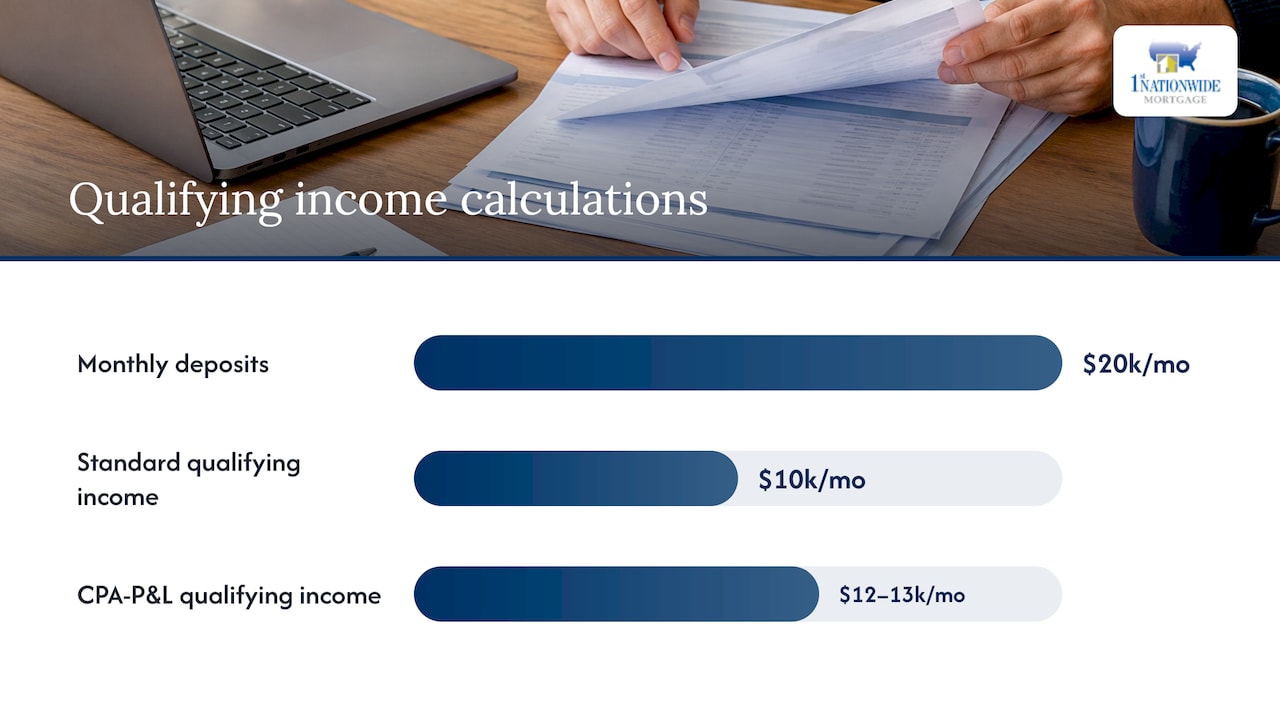
The expense factor. Business account deposits are not all income, because the business has costs. The standard expense factor on business accounts is 50%. In practice, if your business account shows $20,000 a month in deposits, qualifying income starts from $10,000 a month. With a CPA-certified profit and loss statement, that factor can drop to 35% to 40%. That is a meaningful difference: on the same $20,000, the qualifying income rises to $12,000 to $13,000 a month. This is an illustration of the arithmetic, not an offer or a commitment to lend.
Clean statements. Plan on these habits well before you apply:
- Keep business and personal money in separate accounts.
- Avoid large one-off transfers between your own accounts, since they look like deposits but are not revenue.
- Keep a short written explanation ready for any unusually large deposit.
- Pay down revolving balances where you can, since DTI still counts.
For more depth, see our bank statement mortgage guide and our piece on how inconsistent income affects approval. Freelancers can also read our alternative qualification criteria for freelancers, and investors with large write-offs will find the high write-off qualification guide useful.
DSCR loan requirements
DSCR stands for debt service coverage ratio: the property’s rent divided by its monthly housing costs (principal, interest, taxes, insurance and any association dues). If the rent covers the costs with room to spare, the property qualifies itself. Your personal income is not part of the equation.
- Property use: investment and non-owner-occupied properties only. DSCR is never an option for a primary residence.
- Credit: a 640 minimum score.
- Borrower structure: works for LLCs, and there is no limit on the number of properties you finance.
- Documents: typically the lease, or a market rent estimate if the property is vacant, plus proof of the funds you are putting in.
A simple example: a property renting for $2,800 a month with $2,500 in total monthly housing costs has a ratio of 1.12. Higher ratios generally mean stronger files. You can test your own numbers with our DSCR loan calculator, then read about DSCR loans in full. We also have state pages for investors in Colorado and San Diego.
Because DSCR loans are built for investors who add properties over time, the lack of a cap on financed properties is the feature that matters most to portfolio builders. Income from the first rental does not need to be re-proven through your tax returns to finance the fifth.
NONI loans for foreign nationals and no-income borrowers
NONI stands for no income, no asset. It exists for borrowers whose financial lives do not produce U.S.-style documents: foreign nationals buying U.S. investment property, and others with no documentable income. Because the CFPB’s ability-to-repay rule still applies to the loans that fall under it, the file is shaped around the facts of the transaction. Our NONI investment loans are written for investment property, and there is more detail on the NONI program page.
Expect to talk through identity, the property, the intended use and your plan for the purchase. Lenders also verify who you are. For background on how identity checks work at U.S. banks, see this explainer on FinCEN customer due diligence verification.
W-2 borrowers with high DTI
A W-2 employee can land in non-QM territory when DTI is the obstacle, for example when many obligations or a large monthly payment push the ratio past conventional limits. The same ability-to-repay factors apply: income, debts, credit history and the new payment. If you are in California, Colorado, Oregon, Washington, Texas or Idaho and are buying or refinancing an owner-occupied home, our loan programs include conventional, FHA, VA, USDA and jumbo options alongside non-QM. In other states, our programs are business-purpose: investment-property financing through DSCR, non-owner-occupied bank statement loans, NONI, bridge and commercial loans.
Homeowners 62 and older
Reverse mortgages are a separate product from non-QM, built for homeowners 62 and older who want to turn home equity into funds. Reverse mortgages are available through us to homeowners in California, Colorado, Oregon, Washington, Texas and Idaho. The requirements center on age, owning the home, and living in it as your primary residence, rather than on proving monthly income the way a purchase loan does. Our home page is the place to start a conversation.
Prepayment penalties
Some non-QM and investor loans carry a prepayment penalty, a fee for paying the loan off early. Availability and structure vary by state and are restricted in several. Prepayment penalty terms are confirmed at application, so you see the exact structure before you commit.
Documents to gather before you apply
Having these ready shortens the conversation:
- Government photo ID, and for foreign nationals, a passport and the documents specific to your situation.
- 12 to 24 months of business and personal bank statements, every page.
- A CPA-certified profit and loss statement, if you want the lower expense factor.
- For DSCR, the current lease or a rent estimate, plus insurance and tax information on the property.
- Proof of the funds for your down payment and closing costs.
- A list of current debts.
The quality of this package is the best predictor of a smooth file. Missing pages and unexplained transfers cause more delays than a borderline score.
Where to start with us
If you are self-employed, an investor, a foreign national or a borrower whose paperwork does not match your real ability to repay, we can review your scenario against our bank statement, DSCR and NONI programs. A dedicated loan officer personally handles your file rather than a call center.
We are a lender, so the same team that explains the requirements can structure the loan. Start from our loan programs page or contact us at 1stnwm.com.
Our perspective
Most borrowers who come to us are not weak borrowers. They are borrowers whose income is real but does not look right on a tax return: a business owner with legitimate write-offs, an investor whose rentals carry the loan, a foreign buyer with income earned abroad.
We specialize in non-QM and alternative-income mortgages because those files need an underwriting approach that reads the whole picture. Our programs give direct access to specialized underwriting that traditional banks do not offer, and we explain the choices openly: which program fits, how it is structured, and what the documents need to show.
The requirements are the same ones any careful lender applies: verified ability to repay, sound credit, and a down payment you have earned. We simply look for them where your finances actually live.
Christopher Arco, NMLS #1281
FAQ
Is a non-QM loan harder to get than a conventional loan?
It is different rather than harder. Conventional loans lean on W-2s and tax returns, while non-QM programs use bank statements, rental income or assets. You still need to show you can repay, and credit, down payment and documentation still matter.
What credit score do I need for a non-QM mortgage?
It depends on the program. For our bank statement loans the minimum is 620, and for DSCR loans it is 640. Your score, down payment and the property all shape the final terms.
Can I use a DSCR loan for my own home?
No. DSCR loans are for investment and non-owner-occupied properties only, because the property’s rental income is what qualifies the loan. For an owner-occupied purchase, a bank statement or other consumer program may fit, in the states where we offer those.
Does a non-QM loan have a prepayment penalty?
Some do. Availability and structure vary by state and are restricted in several. Prepayment penalty terms are confirmed at application.
Sources
- What is a Qualified Mortgage? (CFPB)
- Supervisory Highlights, Issue 15 (CFPB)
- 12 CFR 1026.43, Minimum standards for transactions covered by ability-to-repay (eCFR)
- FinCEN CDD verification explainer
For illustration only. Not a commitment to lend. NMLS #1281. Equal Housing Lender.