
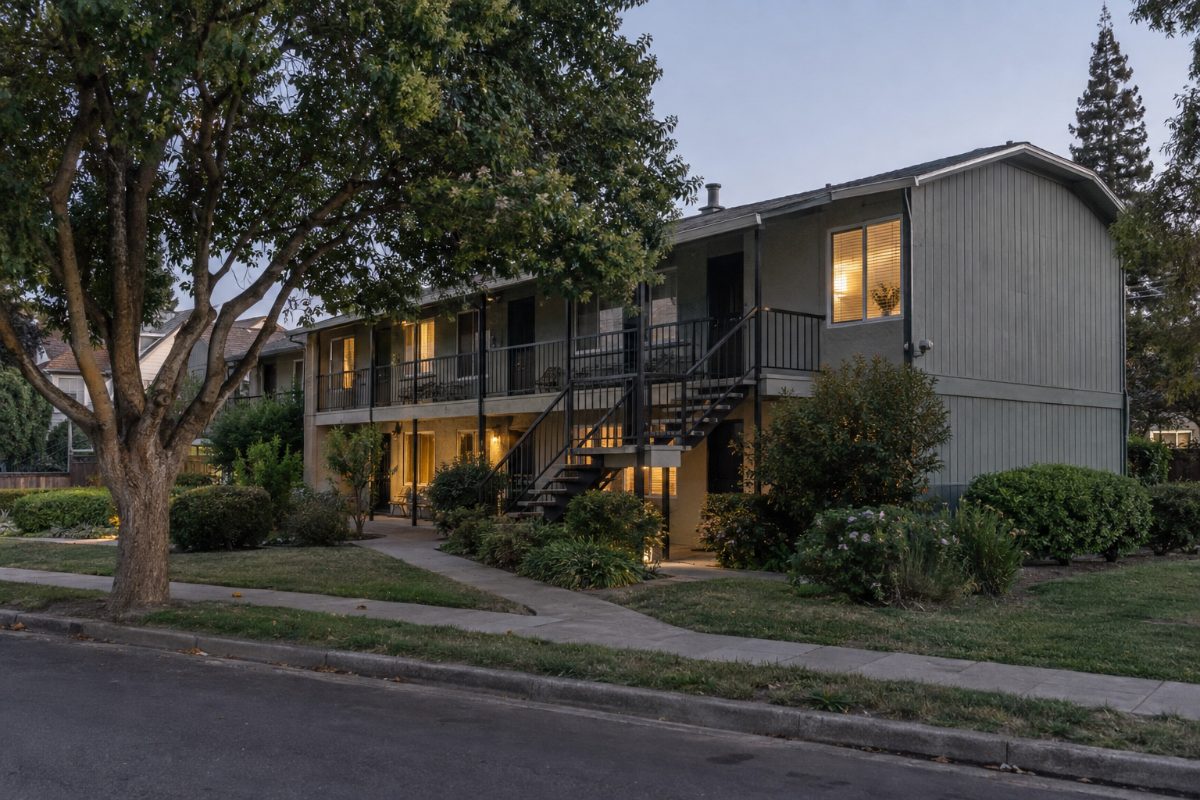
An investor called me last spring with six rentals already in the portfolio. Four single-family houses, one duplex, all financed on rent-based underwriting. He had the routine down. Send the lease, send the appraisal, sign in the LLC, fund in three weeks.
Then he found an eight-unit two towns over. Good bones, 1978 construction, fully occupied.
He asked me to "just do the same thing." We could not. Not because of anything about him — credit in the 740s, cash in the bank — but because the fifth unit moves a property into a different lending category. Different math, different appraisal, different vesting, different term. He spent twenty minutes thinking I was making it complicated. I was not.
The product is simply different on the other side of four units.
What actually changes when a property goes from four units to five?
The loan stops being residential and becomes commercial. That is the whole answer, and everything below is a consequence of it.
One to four units is residential real estate no matter who owns it or why. A DSCR loan lives in that world: residential appraisal forms, thirty-year amortization, a qualifying calculation you can do on a napkin. Five units and up is commercial. The building is valued as a business that produces income, and the loan is written against that income stream rather than a house that happens to have tenants.
People hear "commercial" and picture office towers. An eight-unit in a secondary market is commercial. So is a six-unit. So is a five-unit that looks exactly like the fourplex next door and was built by the same guy in the same year. The secondary market drew that line, and it does not care that your five-unit has the same roof as your four-unit.
Pro Tip: Count the legal units before you write the offer. A converted basement apartment or an unpermitted fifth unit can push a residential deal into commercial territory mid-process and reset your timeline by a month.
How does commercial underwriting calculate income differently than DSCR?
Commercial runs on net operating income, which is what remains after the building's expenses — not gross rent. DSCR on one to four units is gross rent divided by PITIA. The lease or the 1007, whichever is lower, over principal, interest, taxes, insurance and dues. No expense deduction, no vacancy factor, no management fee, no reserves.
Same building, both methods. Eight units averaging $1,450 a month, so $139,200 of gross scheduled rent.
Residential-style math: $139,200 against, say, $62,000 of annual debt service. A 2.25 coverage ratio. Spectacular. Also fiction.
Commercial math takes 5% off for vacancy, putting effective gross income at $132,240, then subtracts what the building costs to run:
- Property taxes: $14,000
- Insurance: $9,500
- Water and sewer: $6,200
- Trash: $2,400
- Common-area electric: $1,800
- Landscaping and snow: $3,000
- Repairs and maintenance: $8,000
- Management at 6% of EGI: $7,934
- Replacement reserves at $250 per unit: $2,000
That is $54,834 of operating expenses. NOI lands at $77,406. Against the same $62,000 of debt service, coverage is 1.25 — not 2.25. Same building, same rent, same borrower. The number an underwriter uses is barely half of what the napkin said.
Two line items catch investors every time. Management is deducted whether or not you hire a manager, because the asset is what gets underwritten and the asset does not care who owns it. Reserves get deducted even though you write that check to nobody. Your self-managed building gets no credit for your labor being free.
What debt service coverage does a commercial lender expect?
Generally 1.20x to 1.25x minimum on NOI, with older or smaller assets in thin markets held closer to 1.30x. Tighter than it sounds, because it is measured against a number already reduced by vacancy and expenses.
Residential DSCR programs work at 1.00x, and a 0.75 ratio has a home on the non-QM side of the business. Commercial does not treat sub-1.00 that casually, because there the ratio is the loan. No personal income behind it.
Practically: coverage, not loan-to-value, is usually the binding constraint. Investors walk in planning 25% down and find the NOI supports a loan 20% smaller than that. The building appraises fine. The coverage does not reach. At 1.25x with $77,406 of NOI, the deal supports roughly $61,900 of annual debt service, and whatever loan amount that corresponds to is your loan amount — regardless of price or what you were willing to put down.
Solve for debt service first, price second. The reverse of how residential investors think, and the biggest adjustment in crossing over.
How is the appraisal different on a 5+ unit property?
You get a full narrative commercial appraisal instead of a residential form with a rent addendum, and the difference is measured in weeks and thousands of dollars.
On one to four units, the appraiser completes a residential form and attaches a 1007 rent schedule — one page of comps supporting market rent. Cheap, fast, mostly there to confirm the lease is not inflated.
On five and up, the appraiser is valuing an income-producing asset. Three approaches to value, with the income approach carrying most of the weight. NOI capitalized at a market cap rate pulled from sales of similar buildings. Sales comparison expressed per unit and per square foot. Sixty to a hundred pages, three to five weeks from engagement, $3,500 to $8,000 — against a few hundred on the residential side.
The valuation mechanics surprise people. On a house, three recent sales down the street set the value. On an apartment building, value is NOI divided by cap rate, and small cap movements swing the number hard. That $77,406 of NOI supports roughly $1,106,000 at a 7.0 cap, about $1,191,000 at 6.5, about $1,032,000 at 7.5. Half a point is $159,000 of value here, and you do not choose the cap rate. The Appraisal Institute sets the standards these reports are written to.
How do the two products compare side by side?
This is the comparison I draw on a legal pad in nearly every one of these conversations.
| 1-4 Units (DSCR) | 5+ Units (Commercial) | |
|---|---|---|
| Qualifying math | Gross rent ÷ PITIA | NOI ÷ annual debt service, net of vacancy, expenses, management, reserves |
| Appraisal | Residential form plus 1007 rent schedule; days, hundreds of dollars | Narrative report, income approach and cap rate; weeks, thousands of dollars |
| Vesting | LLC or individual, borrower's choice on most programs | Entity effectively required, often a single-purpose LLC formed for the property |
| Typical term | 30-year fixed, fully amortizing | 5, 7 or 10-year term on 25 or 30-year amortization, balloon at maturity |
| Recourse | Generally non-recourse to the individual, business-purpose | Usually full or partial recourse with a personal guaranty; non-recourse at scale and lower leverage |
| Documentation | Lease or 1007, insurance, entity docs if vested in an entity | Rent roll, trailing 12-month operating statement, leases, personal financial statement, schedule of real estate owned, entity package |
Why is entity vesting standard on commercial instead of optional?
Because commercial lenders underwrite a borrowing entity rather than a person, and the documents are built for that. On DSCR you can take title either way, and plenty of investors close in their own name. On a 5+ unit loan, expect an LLC, often one that owns nothing else.
The single-purpose requirement isolates the asset. If the borrowing LLC also holds three other buildings and a lawn care business, the collateral is tangled up with obligations nobody underwrote.
The package: articles of organization, operating agreement, EIN letter, certificate of good standing, and a borrowing resolution. Ownership percentages must match what was disclosed, and members above a threshold — usually 20% or 25% — get underwritten individually.
Form the entity early. I have watched deals lose two weeks to a good-standing certificate, which is an absurd thing to lose two weeks to.
What does recourse versus non-recourse actually mean here?
Recourse means the lender can pursue the guarantor personally for a deficiency. Non-recourse means the collateral is the remedy and liability stops at the building. Most 5+ unit financing below institutional size is recourse, and the personal guaranty is what makes it so.
Residential investors get caught by this, because business-purpose DSCR loans are generally non-recourse to the individual. They assume it carries over. It does not.
Non-recourse structures exist on multifamily at larger loan sizes and lower leverage. Even then it is never absolute. There are carve-outs: fraud, misapplication of rents, waste, unauthorized transfers, environmental liability. Trip one and the guaranty springs to full recourse. The industry calls them bad-boy carve-outs, and the name tells you what they are aimed at.
My mildly unpopular position: investors overvalue non-recourse. Chasing it usually means lower proceeds or a worse structure, and if you are not planning to commit fraud or strip rents out of a failing building, the carve-outs cover most of the ground the guaranty does anyway. Optimize the terms that touch cash flow. Recourse is a real consideration, not the first one.
Pro Tip: Read the carve-out schedule on anything marketed as non-recourse. A transfer-of-interest carve-out can convert the note to full recourse if you restructure your own LLC membership, which investors do without telling anyone.
Why do commercial loans have shorter terms and balloon payments?
Because commercial paper is written in periods rather than for thirty years, so the note matures long before the amortization finishes. A 5, 7 or 10-year term on a 25 or 30-year schedule leaves a balance due at maturity. That balance is the balloon.
On a seven-year term with 30-year amortization, roughly 88 to 90% of original principal is still outstanding at maturity. Nobody pays that with cash. You refinance, sell, or exercise an extension option if the note has one. That is the takeout, and it should be a plan formed at closing rather than a problem discovered in year six.
Your takeout depends on conditions at maturity — where cap rates sit, what NOI looks like then, what credit markets are doing that quarter. NOI up and cap rates steady makes it easy. NOI slipped and cap rates wider means the property may appraise below what you need, and you write a check to close the gap.
Which is why operating discipline matters more on a five-year note. Rent growth, expense control and occupancy are not just profit here. They are the refinance.
Prepayment terms belong here too. Commercial notes commonly carry a declining prepay structure or yield maintenance, and specifics vary by lender, structure and state. Know yours before planning an exit inside the penalty window. Commercial financing is the one part of our business we do in all 50 states, and the structures are not uniform across them.
What should an investor do before making an offer on a 5+ unit building?
Get the operating data before getting attached to the building:
- Request the trailing twelve-month operating statement and a rent roll with lease start and end dates. If the seller will not produce them, you are not buying an income property, you are buying a story.
- Build your own NOI with lender assumptions: 5% vacancy, market-rate management whether or not you self-manage, reserves per unit.
- Divide NOI by 1.25 to find supportable annual debt service, then work that backward into a realistic loan amount.
- Compare that to the price. The difference is your real down payment, frequently larger than the 20 to 25% residential deals trained you to expect.
- Form the entity and pull the good-standing certificate while you are still negotiating.
Credit matters on the commercial side as a gate rather than the engine. Our published residential DSCR tiers — 640 floor, 680 standard, 740 for the best terms — are a fair orientation for the guarantor. The building carries the file. You can verify our record at NMLS Consumer Access; NMLS #1281, A+ rated with the BBB, all of it business-purpose lending on investment property.
The investor with six rentals closed his eight-unit. LLC vesting, seven-year term, personal guaranty, an appraisal that took four weeks, not ten days. He put more down than planned because coverage capped the loan below what the price implied. The building has performed since. He learned the rules after going under contract, which is the expensive way.
For illustration only. Not a commitment to lend. NMLS #1281. Equal Housing Lender.