
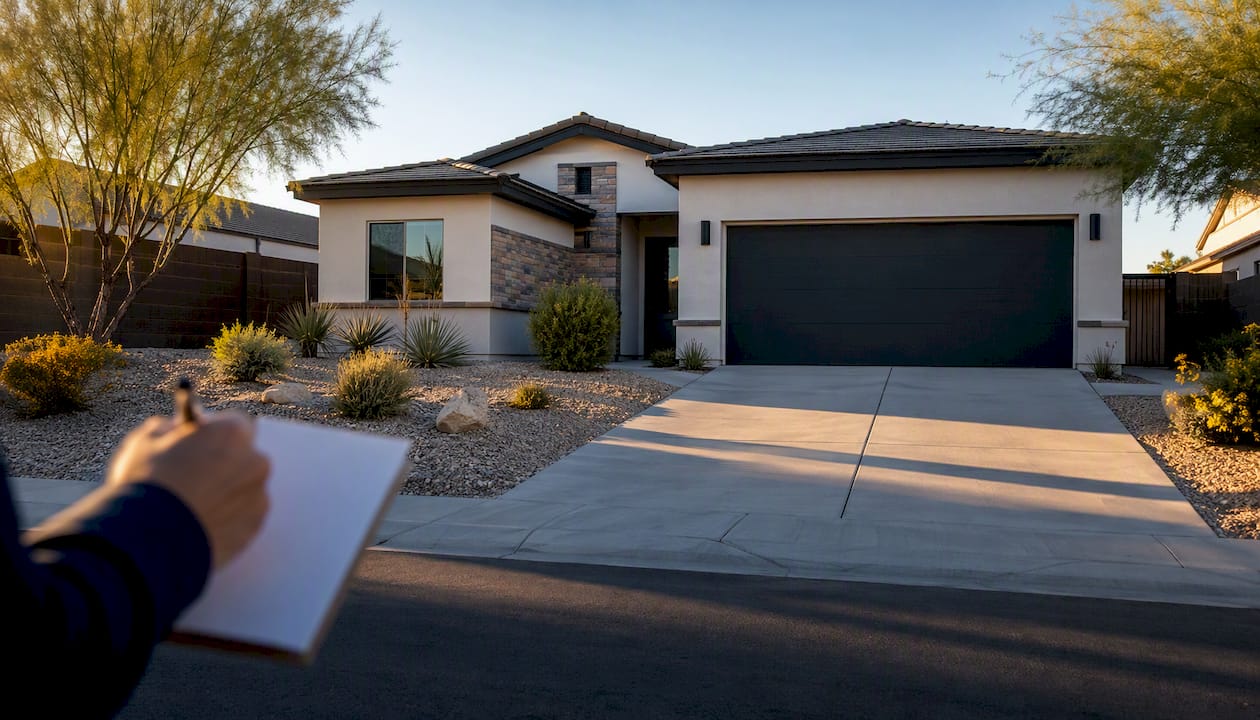
Las Vegas is a legitimate investment market right now — but the strategy you choose determines whether you’re buying cash flow or buying appreciation, and those are two different cities. Workforce submarkets like North Las Vegas offer cap rates in the 4%–6% range with predictable tenant demand. Premium submarkets like Summerlin and Henderson skew toward long-term appreciation with thinner current yields. Knowing which game you’re playing before you write an offer is the single most important underwriting decision you’ll make.
Three numbers to anchor your analysis:
- Median list price: approximately $474,950 (June 2026, per Realtor)
- Metro median asking rent: $1,456/month (June 2026, down 1.8% year-over-year)
- Typical single-family cap rate: 4%–6% across the metro
Your immediate next steps: run rent comps on Zillow or Redfin for the specific zip code, confirm HOA rental restrictions, and decide whether you’re financing with a DSCR loan (rental income qualifies, no personal income docs) or a conventional investor mortgage. Cash-flow deals reward conservative underwriting. Appreciation plays require patience and a longer hold horizon.
Key Takeaways
Las Vegas investment property works best when you match your submarket to your strategy, underwrite conservatively, and line up financing before you make an offer.
| Point | Details |
|---|---|
| Metro rent and price baseline | Median asking rent is $1,456/month (June 2026, down 1.8% YoY); median list price is approximately $474,950. |
| Cap rate range | Single-family rentals across the metro typically yield 4%–6%; cash-flow deals concentrate in North Las Vegas. |
| Submarket strategy | North Las Vegas for cash flow; Henderson and Summerlin for appreciation; STR zones require parcel-level permit verification. |
| Evaluation priorities | Model 8% vacancy and 5% CapEx reserve; inspect HVAC and roof; confirm HOA rental caps before closing. |
| Financing with 1st Nationwide Mortgage | DSCR loans qualify on rental income (no personal income docs); bank-statement and NONI programs available for self-employed and nontraditional borrowers. |
Table of Contents
- Where to find current Las Vegas investment listings
- What does the Las Vegas market look like for investors right now?
- Which Las Vegas submarkets match your investment strategy?
- Sample Las Vegas investment property analyses with real deal math
- How to evaluate any Las Vegas investment property before you buy
- How do investors typically finance Las Vegas investment purchases?
- What does it cost to close on a Las Vegas investment property?
- Property management options and exit strategies for Las Vegas investors
- A calm expert’s perspective on Las Vegas investing
- How 1st Nationwide Mortgage helps Las Vegas investment buyers close
- Sources
Where to find current Las Vegas investment listings
Zillow’s investment-condo search is a high-volume starting point for condo and small-multifamily inventory across the metro. Redfin layers in days-on-market data and price-cut history, which matters in a market where active listings have climbed to roughly 8,100, giving buyers real negotiating room. For single-family rentals and off-market pockets, local broker portals and the Nevada MLS (accessed through a licensed agent) surface inventory that national sites miss by days.
Rice Real Estate & Property Management is a locally rooted firm that combines brokerage and property management — useful if you want a single point of contact for acquisition and ongoing operations, particularly for out-of-state investors who need boots on the ground.
Search filters to set on every platform:
- Property type: single-family, condo/townhome, or 2–4 unit
- HOA: filter for low or no HOA first, then evaluate high-HOA properties separately
- Days on market: 30+ days often signals price negotiation room
- Rent estimate (Zillow’s “Rent Zestimate”): cross-check against Rentometer or local PM quotes
- STR/rental zoning: confirm at the parcel level, not just the neighborhood level
Pro Tip: Set saved searches with email alerts on both Zillow and Redfin for your target zip codes. Price reductions trigger a new alert, so you capture motivated sellers before they hit the broader investor radar.
What does the Las Vegas market look like for investors right now?
The headline numbers tell a nuanced story. The metro median asking rent was $1,456 in June 2026 and had eased slightly year-over-year, driven partly by new multifamily deliveries coming online across the valley. That softness is not uniform — some submarkets are holding steadier than others — but it means your rent assumptions should lean conservative, not optimistic.
On the supply side, inventory sits near 8,100 active listings with roughly 3.3 months of supply. That’s a meaningful shift from the 2021–2022 seller market and translates directly into offer leverage. Expect sellers to negotiate on price, closing cost credits, and repair allowances in a way that simply wasn’t possible two years ago.
Key market signals for investors:
- Median list price ~$474,950; active listings up ~3.4% YoY
- Asking rents down 1.8% YoY metro-wide; Henderson specifically saw sharper YoY declines driven by new supply
- Days on market trending longer, with a rising share of listings taking price cuts
- Multifamily permit activity rebounded in 2025, adding near-term supply pressure in some corridors
UNLV’s Center for Business and Economic Research publishes permit activity and employment forecasts for Southern Nevada — bookmark it for longer-term demand validation before committing to a submarket.
The practical read: softer rents give tenants more negotiating power at lease renewal, but elevated financing costs are also driving renter retention and lease renewals, which stabilizes occupancy for existing landlords. Vacancy risk is real but manageable if you price competitively from day one.
Which Las Vegas submarkets match your investment strategy?
The metro breaks into distinct investor profiles. Choosing the wrong submarket for your strategy is more costly than choosing the wrong paint color.
- North Las Vegas: Strongest cash-flow profile in the metro. Lower price points, higher gross yields, workforce tenant base. Best fit for buy-and-hold investors prioritizing monthly income over appreciation. Expect more active management needs.
- Henderson / Green Valley: Appreciation-oriented with stable, higher-income tenants. Cap rates run thinner, but vacancy is lower and tenant quality tends to be stronger. Green Valley Ranch and Anthem are particularly sought after.
- Summerlin: Premium appreciation play on the west side. Master-planned community with strict HOA rules — verify rental allowances carefully before buying. Nevada’s no-state-income-tax advantage compounds returns here for out-of-state investors fleeing high-tax states.
- Paradise / Strip-adjacent: STR-eligible zones exist here, but parcel-level licensing is required and Clark County’s STR regulations have tightened. Higher purchase prices demand strong nightly rates to pencil out.
- Spring Valley: Mid-tier pricing with solid long-term rental demand. Good balance of price point and tenant stability. Less appreciation upside than Henderson but better cash flow than Summerlin.
- Enterprise corridor: Emerging growth area in the southwest. New construction, younger tenant demographic, and improving infrastructure. Appreciation potential is real but unproven over a full cycle.
Before targeting any neighborhood for a short-term rental, run a parcel-level check with Clark County or the City of Las Vegas. Neighborhood-level STR guidance is directional only. A single HOA or zoning restriction can eliminate the STR premium entirely — and you won’t find that on a listing sheet.
Pro Tip: For out-of-state investors, pairing a cash-flow asset in North Las Vegas with an appreciation hold in Henderson creates a portfolio that generates current income while building long-term equity — two different risk profiles working together.
Sample Las Vegas investment property analyses with real deal math
These three examples use illustrative assumptions you can adapt to actual listings. Run your own numbers with a cap rate calculator or the DSCR loan calculator to stress-test any deal before making an offer.
Formulas used:
- NOI = Gross Rent – Operating Expenses (taxes + insurance + HOA + vacancy + CapEx)
- Cap Rate = NOI ÷ Purchase Price
- Cash-on-Cash Return = Annual Pre-Tax Cash Flow ÷ Total Cash Invested
Example A’s cap rate of 4.0% sits at the low end of the 4%–6% metro range IRES documents, reflecting current rate levels. Example B is a pure appreciation play — negative cash flow is the cost of holding a premium asset. Example C’s STR math only works with consistent occupancy and a valid STR license; model it at 65% occupancy, not 85%.
Pro Tip: IRES flags that investors most commonly undermine their own returns by excluding closing costs, vacancy, and CapEx from their models. Build all three in from the first calculation, not as an afterthought.
Use the cash-on-cash return calculator to model different down payment scenarios and see how leverage changes your return profile.
How to evaluate any Las Vegas investment property before you buy
A disciplined evaluation process protects you from deals that look good on a listing sheet but break down under scrutiny. Work through these steps in order.
- Run rent comps first. Pull active rental listings and recently leased comps within 0.5 miles on Zillow, Redfin, and a local PM’s rental feed. The metro median of $1,456/month (June 2026) is a reference point, not your target rent — actual achievable rent depends on beds, baths, condition, and zip code.
- Estimate realistic operating expenses. Property tax (Clark County assessor), insurance quote, HOA fees (request the full HOA financials, not just the monthly dues), and any owner-paid utilities.
- Model vacancy and CapEx conservatively. Use 8% vacancy and 5% CapEx reserve as a floor, not a ceiling. Las Vegas summers are brutal on HVAC systems — budget for a full unit replacement ($4,000–$7,000) within your hold period.
- Calculate NOI and cap rate. Use the formulas above. If the cap rate doesn’t clear your minimum threshold, the deal doesn’t work at that price — negotiate down or walk.
- Inspect HVAC, roof, and AC capacity. These are the three most common deal-breakers in Las Vegas. A 15-year-old HVAC system in a desert climate is a near-term capital expense, not a deferred one.
- Confirm HOA rental rules. Some HOAs cap the percentage of units that can be rented at any time. If the cap is already near its limit, you may not be able to rent immediately after closing.
- Verify STR zoning at the parcel level. If you’re targeting a short-term rental, confirm the specific parcel is eligible under Clark County or City of Las Vegas ordinances before you’re under contract.
Additional checks:
- Pull title for liens, easements, or CC&R restrictions
- Request 12 months of utility bills from the seller
- Compare your rent estimate against a local PM’s opinion of value, not just an algorithm
Pro Tip: The most common inspection red flags in Las Vegas deals are deferred HVAC maintenance, flat-roof drainage issues, and pool equipment in poor condition. Any of these can add $10,000–$25,000 to your rehab budget. Get a specialist inspection for each, not just a general home inspection.
How do investors typically finance Las Vegas investment purchases?
Nevada investment-property financing runs through several distinct loan structures, and the right one depends on your income documentation, entity structure, and deal type. Because Nevada is not among the states where owner-occupied consumer products apply, Las Vegas investment-property financing runs through business-purpose lending programs.
- DSCR loans: The property’s rental income qualifies the loan — your personal income is not in the equation. Works for LLCs, no limit on financed properties. Minimum credit score and down payment requirements apply. DSCR loans are investment/non-owner-occupied only.
- Bank-statement investor programs: For self-employed investors whose tax returns understate income due to write-offs. 12–24 months of bank deposits replace tax returns as the qualifying income source. Bank-statement programs are available in qualifying states — confirm availability at application.
- NONI (No Income, No Asset): Designed for foreign nationals and borrowers with no documentable income. Loan amounts up to $3.5M. Qualification is based on the asset and deal structure rather than personal income.
- Conventional investor mortgages: Available for qualifying borrowers with documented W-2 or self-employment income, typically requiring 20–25% down on investment properties. Debt-to-income ratio limits apply and can constrain investors with multiple financed properties.
- Cash and bridge/rehab financing: All-cash offers close faster and carry no financing contingency risk. Bridge loans cover short-term acquisition and rehab before a refinance or sale.
Matching your financing type to your strategy matters as much as the rate. A cash-flow deal in North Las Vegas often pairs cleanly with a DSCR loan — the rent covers the debt service and qualification is straightforward. A premium appreciation hold in Summerlin may require a bank-statement or conventional program if the rent-to-price ratio doesn’t support DSCR coverage. For STR deals, lenders typically require a valid STR license before closing — don’t assume the license transfers with the property.
Pro Tip: If you’re buying through an LLC, DSCR is often the cleanest path — it keeps the loan in the entity, protects personal assets, and doesn’t count against your personal DTI. Confirm your entity structure with your attorney before application.
Product availability varies by state. Rates are illustrative only and not a commitment to lend. Terms are confirmed at application.
What does it cost to close on a Las Vegas investment property?
Closing costs on a Closing costs on Las Vegas investment purchases typically run 2%–3%.% of the purchase price, but your total cash-to-close is higher once you account for reserves and initial setup costs.
Budget line items:
- Earnest money deposit (typically 1%–2% of purchase price, credited at close)
- Down payment (20%–25% for investment properties on most loan programs)
- Lender origination and processing fees
- Appraisal ($500–$800 for single-family; higher for multifamily)
- Title insurance and escrow fees
- Home inspection ($350–$600) plus specialist inspections (HVAC, roof, pool)
- HOA transfer fee and working capital deposit (varies by HOA)
- 30–90 day vacancy reserve (one to two months of projected operating expenses)
- Initial repair and make-ready budget
Typical timeline from accepted offer to close:
- Accepted offer and executed purchase agreement: Day 1
- Earnest money deposited: Day 1–3
- Inspection period: Days 5–15 (negotiate repairs or credits)
- Loan application submitted and appraisal ordered: Days 5–10
- Appraisal completed: Days 15–25
- Loan processing and underwriting: Days 15–30
- Clear to close issued: Days 28–35
- Final walkthrough and closing: Days 30–40
Common delay causes: title issues (liens, HOA delinquencies), appraisal gaps, HOA document delays, and incomplete borrower documentation.
Pre-clear items to speed closing:
- Order a preliminary title report early and resolve any clouds immediately
- Request HOA financials, meeting minutes, and rental cap status upfront
- Have proof of funds or loan pre-approval ready before submitting an offer
Pro Tip: For investment purchases, having your financing pre-structured — not just pre-approved — before you make an offer gives you a credible closing timeline to present to sellers. A 30-day close beats a 45-day close in a negotiation, even at the same price.
Property management options and exit strategies for Las Vegas investors
Self-manage vs. hire a local property manager. Local property management firms in Local property management firms typically charge 8%–10% of collected rent for single-family homes, plus a leasing fee of 50%–100% of one month’s rent for tenant placement.% of one month’s rent for tenant placement. For out-of-state investors, that fee is almost always worth it — local PMs handle maintenance calls, tenant screening, and legal compliance in real time. Self-managing from another state is possible but creates meaningful operational risk, particularly around Nevada’s specific notice and eviction procedures.
STR management adds another layer. Licensed short-term rental operators need dynamic pricing tools, linen and cleaning logistics, and guest communication systems. Many short-term rental owners use a co-host or specialized management firm that charges 20%–30% of gross revenue.% of gross revenue. Before committing to an STR strategy, verify the parcel-level permit status and confirm the HOA (if any) permits short-term rentals. Review the rental property owner protection checklist to understand insurance, screening, and liability considerations before your first tenant moves in.
Nevada landlord-tenant environment. Nevada has no statewide rent control, which gives landlords flexibility to adjust rents at lease renewal. The eviction process, while not instant, is more landlord-friendly than many coastal states. Investment properties in Nevada are subject to an 8% property-tax cap on assessed value increases per year, which limits tax-bill volatility on a hold.
Nevada’s zero state income tax is a genuine after-tax advantage for rental investors, particularly those relocating from California or other high-tax states. The savings compound over a multi-year hold and improve effective cash-on-cash returns without changing a single line of your deal model.
Exit strategies. Three paths dominate:
- Refinance to pull equity: Use a cash-out refinance calculator to model how much equity you can access after appreciation without triggering a sale.
- Hold for appreciation and sell: Standard exit for premium submarket plays. Time the sale to a strong market and price competitively.
- 1031 exchange: Defer capital gains by exchanging into a like-kind investment property. The IRS guidance on like-kind exchanges explains the 45-day identification and 180-day closing windows. Work with a qualified intermediary — the rules are strict and errors are costly.
A calm expert’s perspective on Las Vegas investing
Las Vegas rewards investors who pick a lane and underwrite it honestly. The market’s appeal is real: no state income tax, a growing population, a diversified economy that has moved well beyond gaming, and a rental base that is increasingly sticky due to elevated homeownership costs. But the investors who struggle here are the ones who buy in a premium submarket expecting cash flow that the numbers never supported, or who model STR income at peak occupancy without accounting for licensing risk, seasonality, or HOA restrictions.
The most durable portfolio strategy I’ve seen in this market combines a cash-flow asset in a workforce submarket with a longer appreciation hold in Henderson or Summerlin. The cash-flow property covers carrying costs and generates current income; the appreciation hold builds equity over a 5–10 year horizon. Neither position requires the other to perform perfectly, and the combination reduces the risk of a single submarket bet.
Conservative underwriting is not pessimism. It’s the discipline that separates investors who build portfolios from those who sell after one bad year. Model vacancy at 8%, CapEx at 5%, and rent at the current market rate — not the rate you hope to achieve in 18 months. If the deal works at those numbers, it’s a real deal.
How 1st Nationwide Mortgage helps Las Vegas investment buyers close
For investors who need financing that matches how they actually earn income, 1st Nationwide Mortgage is a direct mortgage banker with a BBB A+ rating and programs built specifically for real estate investors.
The DSCR loan program qualifies on the property’s rental income, not your personal tax returns. It works for LLCs, accommodates investors with multiple financed properties, and is available for Nevada investment-property purchases through business-purpose lending programs. Self-employed investors who can’t show qualifying income on tax returns can use the bank-statement program — 12–24 months of deposits replace W-2s or returns entirely. Foreign nationals and borrowers with no documentable income have a path through the NONI program, with loan amounts up to $3.5M.
Use the DSCR loan calculator to run your target property’s rental income against estimated debt service before you make an offer. When you’re ready to structure financing, contact 1st Nationwide Mortgage directly at 1stnwm.
Product availability varies by state. Rates are illustrative only. Prepayment penalty availability and structure vary by state, and terms are confirmed at application.
Sources
Keep these resources open when you’re underwriting a Las Vegas property:
- Realtor
- Las Vegas Rental Market Report 2026 | IRES
- Las Vegas Real Estate Investing in 2026: Strategies and ROI
- Las Vegas Real Estate Investing in 2026: Where to Start | ViewVegasNow
- Rents continue their free fall in the Las Vegas Valley, report says — Las Vegas Review-Journal
- Center for Business and Economic Research — UNLV
- Like-Kind Exchanges (1031) — IRS
- Investment Condo - Las Vegas NV Real Estate — Zillow
For STR legality, rely on parcel-level checks through Clark County’s online permit portal or the City of Las Vegas planning department — neighborhood reputation is not a substitute for a verified permit status.
For illustration only. Not a commitment to lend. Rates and terms subject to change and qualification. 1st Nationwide Mortgage Corporation, NMLS #1281. Equal Housing Lender.